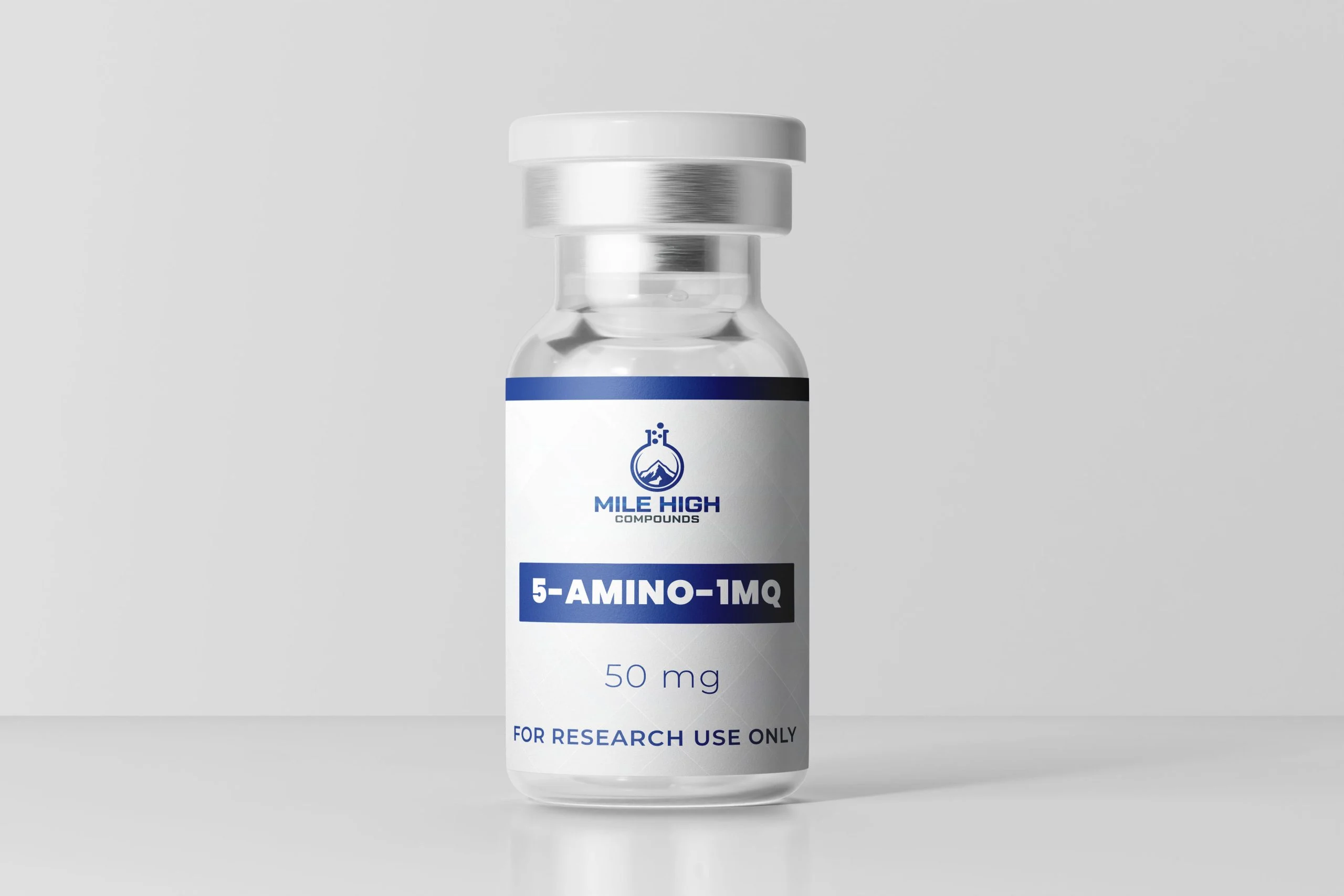
5-Amino-1MQ: 7 Essential Facts About Metabolic Research and Safety
5-Amino-1MQ is an experimental small molecule studied for its potential effects on cellular metabolism and body-fat regulation. It has attracted attention in research and wellness discussions because it inhibits nicotinamide N-methyltransferase (NNMT), an enzyme involved in metabolic processes. Despite online claims about fat loss and metabolic enhancement, evidence remains limited to laboratory and animal research.
At Mile High Compounds, this guide examines 5-Amino-1MQ’s proposed mechanism, scientific findings, limitations, safety concerns, and regulatory status.
1. What Is 5-Amino-1MQ?
5-Amino-1MQ, also called 5-amino-1-methylquinolinium, is a synthetic small molecule investigated as an inhibitor of NNMT. Although it is often marketed alongside peptides and other research compounds, it is not a peptide because it does not consist of an amino-acid chain linked by peptide bonds.
Researchers became interested in this compound because NNMT participates in biochemical pathways associated with energy metabolism and methyl-group transfer. These pathways are relevant to several areas of biomedical research, including obesity and cellular aging.
However, an experimental compound’s research potential does not establish that it is an effective treatment. The available evidence does not demonstrate that 5-Amino-1MQ is safe or effective for weight management in humans. <Cite refs={[“turn844295search5″,”turn844295search12”]}/>
2. How Does 5-Amino-1MQ Work?
NNMT is an enzyme that uses S-adenosylmethionine (SAM) to methylate nicotinamide, producing N1-methylnicotinamide. This process connects NNMT activity with cellular methylation chemistry and pathways involved in nicotinamide metabolism.
Researchers have proposed that inhibiting NNMT may influence cellular NAD+ availability and SAM-related metabolic processes. NAD+ is an important cofactor in numerous cellular reactions, including those involved in energy production.
Laboratory investigations have explored whether 5-Amino-1MQ can alter these pathways in cells and animal models. Nevertheless, the consequences of inhibiting NNMT throughout the human body are not fully understood. A plausible biochemical mechanism does not prove that the compound improves metabolism, reduces body fat, or benefits human health. <Cite refs={[“turn844295search12″,”turn844295search14”]}/>
3. What Does the Scientific Research Show?
Research on 5-Amino-1MQ has included enzyme studies, cell experiments, and animal models.
A foundational 2018 study investigated NNMT inhibition in the context of obesity. Researchers reported changes in fat-related outcomes in mice treated with 5-Amino-1MQ. These findings helped establish interest in the compound as a possible research tool for studying metabolic regulation. <Cite refs={[“turn844295search5″,”turn844295search7”]}/>
Subsequent preclinical investigations have explored NNMT inhibition alongside dietary changes and in models of aging-related muscle function. However, animal studies cannot establish the same results in humans, and short-term observations do not reveal long-term safety.
The evidence base remains limited. As of October 2026, the sources reviewed for this article do not establish completed human clinical trials of 5-Amino-1MQ. Human pharmacokinetics, clinical effectiveness, and a reliable human safety profile remain unestablished. <Cite refs={[“turn844295search0″,”turn844295search4”]}/>
4. 5-Amino-1MQ and Weight-Loss Claims
5-Amino-1MQ is frequently promoted online as a potential fat-loss or metabolic-support compound. These claims largely derive from preclinical research examining NNMT inhibition and body composition in mice.
Although animal findings may justify further investigation, they do not demonstrate that the compound causes meaningful weight loss in people. Human metabolism, drug absorption, enzyme activity, and potential adverse effects can differ substantially from those observed in rodents.
There is also insufficient evidence to determine whether any effect would persist over time, improve health outcomes, or outweigh possible risks. Claims that 5-Amino-1MQ reliably burns fat, preserves muscle, or produces predictable weight changes in humans should therefore be regarded as unproven.
Further research would need to establish safety, appropriate pharmacological characteristics, and clinically meaningful outcomes before therapeutic claims could be justified.
5. Potential Benefits and Research Applications
Scientists study NNMT because it is connected to several biological pathways of interest. These include cellular energy metabolism, methylation processes, and changes observed in certain metabolic conditions.
Potential research areas include:
- Metabolic regulation: Investigating how NNMT inhibition affects cellular metabolism.
- Adipose tissue biology: Exploring mechanisms associated with fat-cell function.
- NAD+ pathways: Studying the relationship between nicotinamide metabolism and cellular energy processes.
- Aging-related research: Examining how metabolic pathways change in aging animal models.
These are areas of scientific investigation, not established benefits of taking 5-Amino-1MQ. In particular, effects observed with other NNMT inhibitors or genetic manipulation of NNMT should not automatically be attributed to this specific compound. <Cite refs={[“turn844295search5″,”turn844295search14”]}/>
6. Safety, Side Effects, and Unknown Risks
The safety profile of 5-Amino-1MQ in humans is unknown. There is insufficient clinical evidence to characterize its adverse effects, interactions, long-term consequences, or effects on different organs and biological systems.
NNMT is involved in interconnected metabolic pathways, so inhibiting it may have effects beyond those initially investigated in laboratory studies. The long-term consequences of changing these pathways in humans have not been adequately characterized.
Products sold through research-chemical channels may also present quality concerns, including incorrect identity, contamination, impurities, and inconsistent concentrations. A supplier’s purity statement does not establish clinical safety.
Because adequate human safety data are lacking, it would be inappropriate to assume that 5-Amino-1MQ is safe simply because some animal experiments reported promising metabolic findings. It should not replace established medical care or evidence-based weight-management approaches. <Cite refs={[“turn844295search0″,”turn844295search6”]}/>
7. Is 5-Amino-1MQ FDA-Approved?
5-Amino-1MQ is not an FDA-approved medication in the United States. The available evidence reviewed for this article does not establish authorization for weight loss, metabolic disease, anti-aging treatment, or any other medical indication. <Cite refs={[“turn844295search4″,”turn844295search5”]}/>
Its sale as a research chemical does not mean that it has undergone the clinical testing required to establish human safety and effectiveness. Nor does its availability online establish that a product meets pharmaceutical quality standards.
Regulatory requirements differ between jurisdictions, so researchers should consult the relevant authority for local requirements. Anyone evaluating claims about 5-Amino-1MQ should distinguish experimental research status from authorization for human medical use.
Frequently Asked Questions About 5-Amino-1MQ
Is 5-Amino-1MQ a peptide?
No. It is a synthetic small molecule that inhibits the NNMT enzyme, despite often being listed alongside research peptides.
Does 5-Amino-1MQ help with weight loss?
Animal research has reported changes in body weight and fat-related outcomes, but human weight-loss benefits have not been established.
What does NNMT do?
NNMT is an enzyme involved in nicotinamide metabolism and methyl-group transfer. Researchers study it because these processes are connected to cellular metabolism.
Are the side effects of 5-Amino-1MQ known?
Human safety data are insufficient to establish its side effects, interactions, or long-term risks.
Is 5-Amino-1MQ FDA-approved?
No. It is not an FDA-approved medication, and its safety and effectiveness in humans have not been established.
Conclusion
5-Amino-1MQ is an experimental NNMT inhibitor that has generated scientific interest because of its potential influence on metabolic pathways. However, the evidence remains preclinical, and its effects on human body composition, metabolism, and long-term health are unknown. More rigorous research is necessary before the compound’s therapeutic value or safety can be established.
Educational disclaimer: This article is for informational and scientific education purposes only. It is not medical advice and does not recommend experimental compounds for diagnosing, treating, curing, or preventing disease.


Reviews
There are no reviews yet.