
BPC-157 Capsules: 7 Essential Facts About Oral Peptide Research and Safety
BPC-157 Capsules are discussed in online research and wellness communities for their proposed relationship to gastrointestinal health, tissue repair, and inflammatory pathways. However, interest in a research compound should not be confused with proven clinical benefits. BPC-157 is a synthetic peptide that has primarily been investigated in laboratory and animal studies, and reliable evidence supporting oral capsules in humans remains limited.
Mile High Compounds — Your source for research compounds, peptide information, and science-driven insights — presents this educational overview to explain what BPC-157 is, what researchers have investigated, and what is currently known about oral formulations and safety.
1. What Are BPC-157 Capsules?
This, short for Body Protection Compound-157, is a synthetic peptide consisting of 15 amino acids. Researchers have investigated its biological activity in various experimental models, including studies involving gastrointestinal tissues, tendons, ligaments, and inflammatory processes.
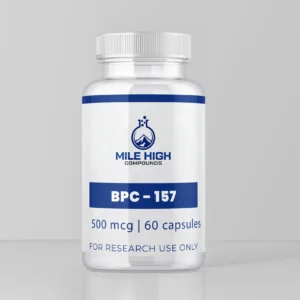
This Capsules refer to oral products marketed as containing this peptide. Products may differ in formulation, manufacturing quality, ingredient composition, and storage requirements.
Importantly, a capsule labeled BPC-157 does not automatically have verified peptide identity, purity, stability, or absorption. These characteristics require appropriate analytical testing and documented quality controls.
2. How Does BPC-157 Work in Research?
Preclinical studies have explored several possible biological pathways associated with BPC-157, including signaling involved in inflammation, cellular responses, blood vessel formation, and tissue maintenance.
These findings have generated scientific interest, but the precise mechanisms remain incompletely understood. Biological effects observed in isolated cells or animals may not translate into meaningful benefits in humans.
A 2026 review identified substantial gaps in pharmaceutical development, including insufficient characterization of human pharmacokinetics and the absence of a validated pharmaceutical formulation. <Cite refs={[“turn372674search2″,”turn372674search6”]}/>
Consequently, proposed mechanisms should be treated as research hypotheses rather than proof that BPC-157 Capsules produce a particular health outcome.
3. BPC-157 Capsules and Oral Absorption
Oral delivery is an important research question because peptides can be broken down by digestive enzymes and may have difficulty crossing the intestinal barrier.
Some preclinical research suggests BPC-157 has unusual stability under certain gastric conditions. However, stability in simulated or experimental gastric environments does not establish how much of an oral capsule reaches the bloodstream or target tissues in humans.
Researchers still need better evidence concerning:
- Oral absorption and bioavailability.
- The influence of capsule formulation and excipients.
- Stability during manufacturing and storage.
- The relationship between exposure and biological effects.
- Differences between animal findings and human outcomes.
A capsule’s advertised formulation or delivery technology is not, by itself, proof of effective absorption. <Cite refs={[“turn372674search2″,”turn372674search7”]}/>
4. What Does the Evidence Say About BPC-157 Capsules?
Much of the published research on BPC-157 involves laboratory experiments and animal models. These studies have explored potential effects on gastrointestinal tissues, musculoskeletal injuries, and other biological processes.
Human evidence remains very limited. A recent evidence review found no eligible randomized controlled human trial meeting its inclusion criteria, while a 2026 scientific review described a small body of uncontrolled human studies across different administration routes. The evidence is insufficient to establish clinical effectiveness. <Cite refs={[“turn372674search4″,”turn372674search2”]}/>
Crucially, findings from injections or specialized local administration cannot automatically be applied to oral capsules. Each route may have different absorption, exposure, and safety characteristics.
At present, BPC-157 Capsules should not be presented as a proven treatment for injuries, digestive disorders, inflammation, or other medical conditions.
5. BPC-157 Capsules: Safety and Regulatory Considerations
The safety profile of BPC-157 in humans is not adequately established. Limited published human observations cannot reliably identify uncommon adverse effects, long-term risks, or interactions with other medicines.
The U.S. Food and Drug Administration identifies potential safety concerns involving compounded BPC-157, including immunogenicity, peptide-related impurities, and challenges in characterizing the active ingredient. The agency states that available safety information is insufficient to determine whether the substance would cause harm in humans. <Cite refs={[“turn372674search0″,”turn372674search17”]}/>
Additional considerations include:
- Product quality: Labels may not independently verify identity, purity, or potency.
- Long-term exposure: Adequate long-term human safety data are lacking.
- Interactions: Potential interactions with medicines and other compounds are not well characterized.
- Regulatory status: BPC-157 is not an FDA-approved medication.
Consumers should not assume that a product is safe or approved simply because it is sold online or described as a research compound.
6. Research Quality and Product Transparency
Evaluating BPC-157 Capsules requires distinguishing marketing claims from documented scientific evidence. Responsible research communication should identify the type of evidence supporting each claim and acknowledge where information is missing.
When assessing information about a product, useful quality questions include whether the manufacturer provides independent identity and purity testing, transparent ingredient information, appropriate storage guidance, and traceable manufacturing details.
A certificate of analysis may provide useful information, but its reliability depends on the laboratory, testing methods, sample traceability, and the specific attributes measured. It does not establish clinical effectiveness or prove that a product is safe for human use.
For researchers and readers, transparent reporting and reproducible evidence are more meaningful than testimonials or unsupported promises.
7. The Future of BPC-157 Capsules Research
Future development would require well-designed studies that establish the peptide’s identity, formulation stability, oral absorption, dose-related exposure, and safety before its clinical benefits could be assessed reliably.
Controlled human trials would also need to examine specific medical conditions using clearly defined outcomes, appropriate comparison groups, and sufficient follow-up. Evidence from one indication or delivery route would not automatically validate other uses.
Until these research gaps are addressed, claims about the effectiveness of BPC-157 Capsules should remain cautious and evidence-based.
Frequently Asked Questions About BPC-157 Capsules
Are BPC-157 Capsules FDA-approved?
No. BPC-157 is not an FDA-approved medication. Compounded products are not FDA-approved, and their safety, effectiveness, and quality are not reviewed by the FDA before marketing in the same way as approved drugs. <Cite refs={[“turn372674search0″,”turn372674search3”]}/>
Are oral BPC-157 Capsules proven to work?
No. Human evidence is insufficient to establish their effectiveness, and findings from animal studies cannot confirm benefits in people.
Is the oral form better than injections?
There is insufficient comparative human evidence to establish that oral capsules are more effective, safer, or more reliable than injectable forms. Different administration routes require separate evaluation.
What are the known side effects?
The available evidence is too limited to define a reliable side-effect profile. Lack of sufficient reports does not mean the compound is free from risk.
Can BPC-157 Capsules replace medical treatment?
No. They should not replace a clinician’s assessment or established treatment for injuries, gastrointestinal symptoms, or other health concerns.
Conclusion
BPC-157 Capsules remain an experimental topic with substantial unanswered questions about oral absorption, clinical effectiveness, product quality, and human safety. Although preclinical findings have prompted further scientific interest, they do not establish proven health benefits in humans.
Mile High Compounds supports informed, science-driven research communication. Readers should prioritize credible evidence, transparent product information, and appropriate medical guidance when evaluating experimental compounds.
Educational disclaimer: This article is for informational purposes only and is not medical advice. BPC-157 is not an FDA-approved medication. This content does not recommend human use, provide dosing instructions, or claim that the compound treats or prevents disease.


Reviews
There are no reviews yet.