
GHK-Cu: 7 Essential Facts About Copper Peptide Research and Skin Health
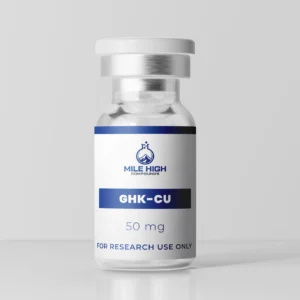
GHK-Cu is a copper-binding peptide that has attracted scientific and cosmetic interest because of its potential role in skin appearance, extracellular matrix remodeling, and cellular repair pathways. Also known as the copper complex of glycyl-L-histidyl-L-lysine, it has been investigated in laboratory experiments, animal models, and a limited number of human cosmetic studies.
At Mile High Compounds — Your source for research compounds, peptide information, and science-driven insights — we believe understanding the difference between promising research and proven clinical outcomes is essential. This guide explores seven important facts about it, its proposed biological activity, research evidence, and safety considerations.
1. What Is GHK-Cu?
This consists of the naturally occurring tripeptide GHK, made from three amino acids—glycine, histidine, and lysine—complexed with copper. Copper is an essential trace element involved in numerous biological processes, including enzyme activity and connective-tissue maintenance.
Researchers have studied it for its interactions with skin cells and extracellular matrix components. In cosmetic products, it is commonly described as a copper peptide associated with skin-conditioning and appearance-related research.
However, different copper-peptide formulations are not necessarily interchangeable. The chemical composition, stability, concentration, and delivery system can influence a product’s characteristics. The presence of it on a product label does not independently demonstrate purity, clinical effectiveness, or safety.
2. How Does GHK-Cu Work?
Laboratory research suggests that it may influence several biological processes, including cellular signaling, inflammatory responses, oxidative stress pathways, and the remodeling of extracellular matrix components.
The extracellular matrix provides structural support to tissues and includes proteins such as collagen and elastin. Researchers have investigated whether it affects pathways involved in the production and organization of these structural components.
Some experimental findings also suggest possible interactions with processes involved in wound repair and blood vessel formation. However, the precise mechanisms and their importance in humans remain under investigation.
These observations provide a scientific rationale for further research, not proof that this reverses aging, repairs damaged tissue, or produces predictable cosmetic results in every user. <Cite refs={[“turn641975search0″,”turn641975search1”]}/>
3. GHK-Cu and Skin Appearance
One of the best-known research areas for this is topical skincare. Researchers have explored its potential relationship with skin texture, the appearance of fine lines, and changes in structural skin components.
Some small studies have reported favorable cosmetic outcomes, but the clinical literature is limited by small participant groups, varying formulations, and differences in study design. Other research has not demonstrated clear objective advantages for specific outcomes.
A 2026 evidence review discussed a small controlled study of a topical GHK-Cu serum for eyebrow hair characteristics. Although the findings were encouraging, the limited sample size means the results require confirmation in larger, independent trials. <Cite refs={[“turn641975search2″,”turn641975search4”]}/>
Consequently,it should be discussed as an ingredient under investigation rather than a guaranteed solution for wrinkles, uneven skin texture, or other cosmetic concerns.
4. GHK-Cu Research on Hair and Tissue Repair
Researchers have also investigated it in experimental models involving hair follicles and tissue repair. These studies examine biological mechanisms that may be relevant to future dermatological applications.
However, evidence from cultured cells or animal experiments cannot establish that a commercial product promotes hair growth or accelerates healing in humans. Human studies of topical cosmetic products are also not sufficient to establish the effectiveness of injectable or oral formulations.
A recent systematic review of it research highlighted a substantial gap between preclinical findings and adequately powered clinical trials. It also emphasized the need for better-defined formulations and more rigorous testing of delivery methods. <Cite refs={[“turn641975search1″,”turn641975search4”]}/>
More independent clinical research is necessary before firm conclusions can be made about specific hair-related or tissue-repair applications.
5. GHK-Cu Safety and Regulatory Status
It’s safety depends on factors such as formulation, purity, route of administration, exposure, and intended use. Evidence concerning one type of topical cosmetic product cannot establish the safety of an injectable or oral product.
Potential concerns include skin irritation or sensitivity, uncertain product quality, contamination, and inadequate information about systemic exposure for routes that bypass the skin barrier.
Experimental or research-grade it should not be assumed to meet pharmaceutical standards. Products marketed online may differ in identity, composition, manufacturing quality, and independent verification.
This is not an FDA-approved medication for anti-aging, hair regrowth, wound healing, or general wellness. Anyone considering a product for a medical concern should consult an appropriately qualified healthcare professional rather than relying on marketing claims.
6. Topical, Oral, and Injectable GHK-Cu: Understanding the Differences
The route of administration is an important distinction in evaluating GHK-Cu research.
Topical GHK-Cu has been investigated in cosmetic formulations applied to the skin. Even here, the strength of evidence varies by product, formulation, and intended outcome.
Oral GHK-Cu raises additional questions about digestive stability, absorption, bioavailability, and whether sufficient intact peptide reaches relevant tissues. Topical studies cannot answer these questions.
Injectable GHK-Cu requires a different level of safety assessment, including appropriate evaluation of sterility, endotoxin contamination, impurities, systemic exposure, and adverse effects.
No route should be presumed superior based on laboratory findings alone. The available evidence does not establish that oral or injectable GHK-Cu provides proven anti-aging or tissue-repair benefits in humans. <Cite refs={[“turn641975search0″,”turn641975search5”]}/>
7. The Future of GHK-Cu Research
Future research could clarify which biological effects are reproducible, which formulations are sufficiently stable, and whether any proposed cosmetic or medical applications produce meaningful benefits in people.
Important priorities include larger randomized controlled trials, independent replication, clearly defined product composition, standardized outcome measurements, and longer-term safety monitoring.
Researchers also need to distinguish the effects of this itself from those of other ingredients in combination products. Without suitable comparison groups, improvements cannot reliably be attributed to a single compound.
For readers following peptide science, the most meaningful developments will be well-designed clinical studies rather than increasingly ambitious marketing language.
Frequently Asked Questions About GHK-Cu
What does GHK-Cu stand for?
GHK-Cu refers to glycyl-L-histidyl-L-lysine complexed with copper. It is commonly called a copper peptide.
Is GHK-Cu proven to reduce wrinkles?
Some small topical studies have reported favorable cosmetic outcomes, but the evidence is limited and does not establish a guaranteed or clinically significant effect across products.
Does GHK-Cu promote hair growth?
Early research includes laboratory findings and limited human cosmetic evidence. Larger, well-designed trials are needed before a reliable hair-growth benefit can be established.
Is GHK-Cu FDA-approved?
GHK-Cu is not an FDA-approved medication for anti-aging, hair growth, wound healing, or general wellness.
Are oral and injectable GHK-Cu as well studied as topical products?
No. Evidence from topical applications cannot establish the absorption, effectiveness, or safety of oral or injectable formulations.
Conclusion
GHK-Cu is an interesting copper-binding peptide with a substantial preclinical research history and a much smaller body of human cosmetic evidence. Its proposed roles in skin appearance, extracellular matrix remodeling, and tissue repair remain areas for further investigation.
Mile High Compounds encourages readers to evaluate GHK-Cu through transparent product information, credible scientific evidence, and a clear understanding of its limitations. Continued independent research is needed before broad therapeutic claims can be considered established.
Educational disclaimer: This article is for informational and educational purposes only and does not constitute medical advice. GHK-Cu is not an FDA-approved medication for the uses discussed. Research findings do not establish that a commercial product is effective or safe for human use.

Reviews
There are no reviews yet.