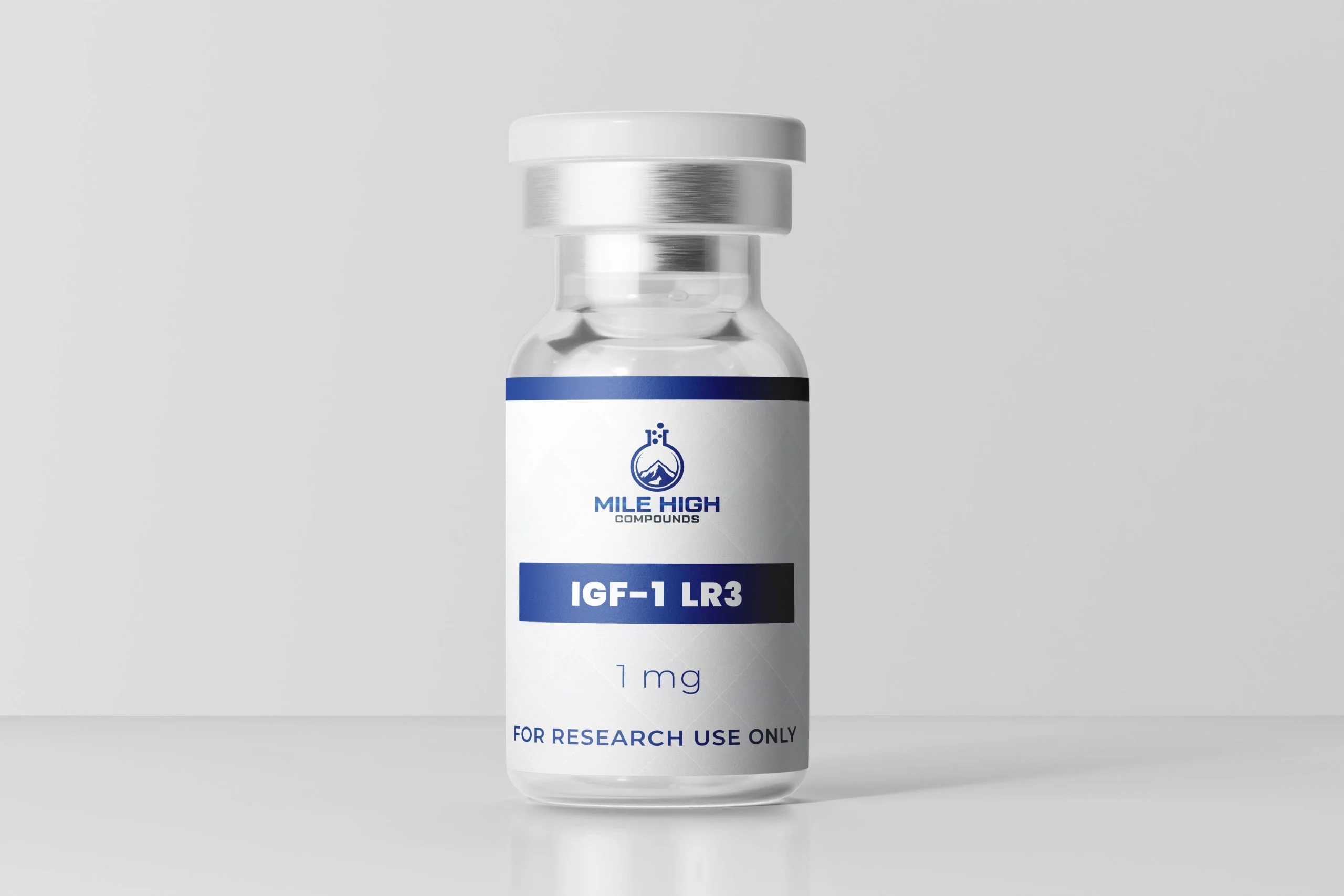
IGF-1 LR3: 7 Essential Facts About Growth Research and Safety
IGF-1 LR3 is an engineered analogue of insulin-like growth factor 1 (IGF-1) studied for its effects on cellular growth, metabolism, and growth-factor signaling. Also known as Long R3 IGF-1, this modified protein has attracted attention in laboratory research and bodybuilding discussions. However, its popularity online should not be confused with established human clinical benefits or proven safety.
At Mile High Compounds, our goal is to provide educational information about research compounds, their biological mechanisms, the strength of available evidence, and important regulatory and safety considerations.
1. What Is IGF-1 LR3?
This is a modified form of insulin-like growth factor 1, a protein involved in normal growth, tissue development, and metabolic regulation. The LR3 analogue contains 83 amino acids, compared with 70 amino acids in native human IGF-1.
Two structural changes distinguish it from native IGF-1: an additional 13-amino-acid sequence at the N-terminus and a substitution of arginine for glutamate at position three. These modifications change how the molecule interacts with IGF-binding proteins. <Cite refs={[“turn206805search2″,”turn206805search22”]}/>
This is a recombinant protein analogue rather than simply another name for natural IGF-1. It is also different from IGF-1 DES, which has a separate structural modification. Evidence about one analogue should not automatically be applied to another.
2. How Does IGF-1 LR3 Work?
IGF-1 participates in biological signaling through the insulin-like growth factor 1 receptor, commonly called IGF-1R. Activation of this receptor can influence cellular growth, survival, differentiation, and protein metabolism.
Naturally occurring IGF-1 also interacts with IGF-binding proteins, which regulate its availability and biological activity. this was designed to have substantially reduced affinity for these binding proteins, potentially changing its biological activity and persistence in experimental systems. <Cite refs={[“turn206805search2″,”turn206805search22”]}/>
These properties make it useful in certain laboratory investigations of growth-factor signaling. However, altered binding characteristics do not establish that the compound produces better results in humans. They may also change the balance between intended biological effects and unwanted consequences.
3. Why Is IGF-1 LR3 Discussed in Muscle Research?
This is frequently discussed in bodybuilding communities because IGF-1 signaling is associated with muscle-cell growth, protein metabolism, and tissue development.
Laboratory studies have examined how the analogue affects cultured cells and animal models. These experiments can help researchers investigate growth-factor pathways, but they do not establish that it safely increases muscle mass, improves athletic performance, or accelerates recovery in people.
A central limitation is the lack of direct human clinical evidence for the LR3 analogue. Findings involving native IGF-1 or the approved medicine mecasermin cannot be treated as proof of equivalent effects from it.
Claims about muscle growth, strength, or body composition should therefore be regarded as unverified for this specific compound rather than established clinical benefits. <Cite refs={[“turn206805search4″,”turn206805search6”]}/>
4. What Does Scientific Research Show?
Published research on it includes structural studies, laboratory experiments, and animal investigations. Researchers have examined its molecular properties, interaction with binding proteins, and effects on biological processes related to growth.
This research provides information about how the molecule behaves under controlled experimental conditions. Nevertheless, laboratory findings and animal results cannot independently determine whether a compound is effective or safe in humans.
A review of the available evidence found no published human clinical trials in which in itself was administered to participants. Consequently, direct human evidence on its effectiveness, pharmacokinetics, dose-response relationships, and adverse effects remains unavailable. <Cite refs={[“turn206805search0″,”turn206805search4″,”turn206805search6”]}/>
This evidence gap is important. Without adequate human studies, researchers cannot reliably determine the benefit-risk balance for bodybuilding, recovery, or general wellness applications.
5. Is IGF-1 LR3 FDA Approved?
This is not FDA-approved for bodybuilding, muscle growth, athletic performance, or general wellness. It is not an approved medicine for these purposes, and products marketed as research materials should not be assumed suitable for human use. <Cite refs={[“turn206805search5″,”turn206805search8”]}/>
Mecasermin, marketed as Increlex in the United States, is a different recombinant form of IGF-1 approved for a specific pediatric growth indication. Its approval and clinical evidence do not extend to it.
Regulatory status also differs from scientific interest. A compound may be investigated in laboratories without being authorized as a medicine. Consumers and researchers should check relevant local regulations and distinguish research materials from approved pharmaceutical products.
6. IGF-1 LR3 Safety and Potential Risks
The safety profile of it in humans has not been adequately established. Because it affects growth-factor pathways, concerns include potentially significant effects on blood glucose regulation and cellular growth. These are important considerations, not a complete or quantified list of known LR3-specific adverse events.
Information about native IGF-1 medicines identifies risks such as hypoglycemia and other serious complications. Those findings highlight the importance of the pathway but cannot establish the exact incidence or full risk profile of it.
Unregulated products present additional concerns, including incorrect identity, contamination, impurities, and inconsistent concentration. A supplier’s label or certificate of analysis does not establish clinical safety or effectiveness.
This should not be treated as a routine supplement. Anyone concerned about exposure or possible adverse effects should seek guidance from a qualified healthcare professional rather than attempting self-treatment.
7. How to Evaluate IGF-1 LR3 Research Information
When reviewing information about it, focus on the quality of the evidence rather than promotional claims. Useful questions include:
- Does the study examine this itself or a different IGF-1 product?
- Was the research conducted in cells, animals, or human participants?
- Are the reported outcomes clinically meaningful or limited to laboratory measurements?
- Does the source clearly describe safety uncertainties and regulatory status?
- Are claims supported by peer-reviewed research or authoritative documentation?
These distinctions are essential because related molecules can have different properties and risk profiles. Evidence should only be applied to the compound, population, and outcome actually studied.
For research organizations, accurate identification and appropriate laboratory procedures are important. For readers, the key is to distinguish experimental findings from proven human benefits and approved medical uses.
Frequently Asked Questions
What is IGF-1 LR3?
This is a modified IGF-1 protein analogue investigated for its effects on growth-factor signaling and related biological processes.
Is IGF-1 LR3 the same as IGF-1?
No. This contains structural modifications that distinguish it from native human IGF-1.
Does IGF-1 LR3 build muscle?
It is discussed for this purpose, but direct human clinical evidence establishing that it safely increases muscle mass is lacking.
Is IGF-1 LR3 FDA-approved?
No. It is not FDA-approved for muscle growth, bodybuilding, or general wellness.
Has IGF-1 LR3 been studied in humans?
Published evidence identified in current research reviews does not establish human administration trials of IGF-1 LR3 itself. Its human effectiveness and safety therefore remain unestablished.
Conclusion
This is an engineered growth-factor analogue with distinct molecular properties and a history of laboratory and animal research. Although its biological mechanisms have attracted interest in muscle and metabolic research, direct human clinical evidence remains insufficient to establish its effectiveness or safety.
Understanding the differences between IGF-1 LR3, native IGF-1, and approved medicines is essential when evaluating scientific claims. Responsible research requires careful interpretation of evidence, transparent documentation, and attention to regulatory requirements.
Educational disclaimer: This article is for informational and educational purposes only. It is not medical advice and does not recommend using research compounds to diagnose, treat, cure, or prevent any disease. Consult a qualified healthcare professional for medical decisions.


Reviews
There are no reviews yet.