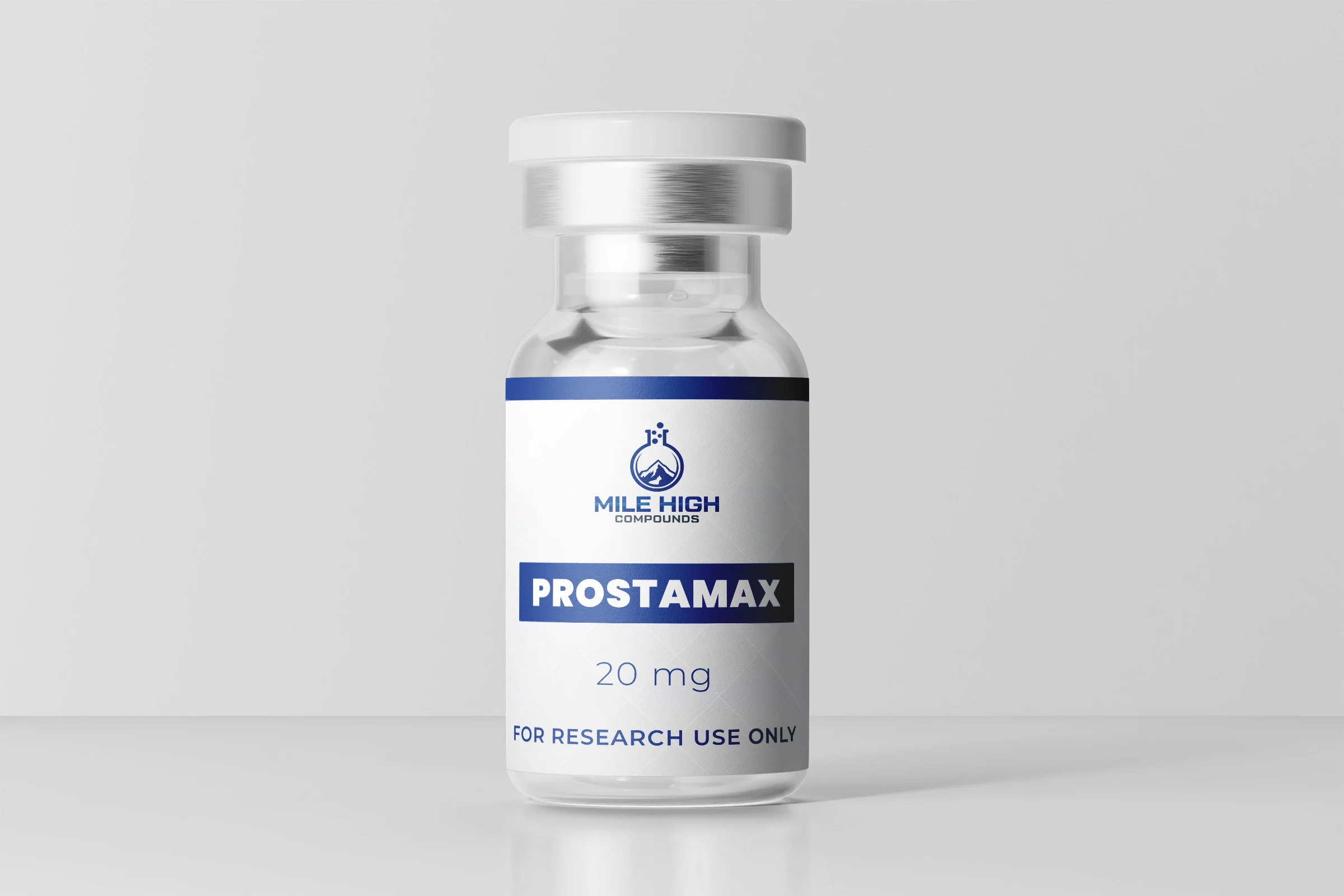
Prostamax: 7 Essential Facts About Prostate Research and Safety
Introduction
Prostamax is described as a synthetic tetrapeptide associated with research into prostate biology. Also known as KEDP, it consists of four amino acids: lysine, glutamic acid, aspartic acid, and proline.
The compound belongs to a family of short peptides sometimes called bioregulators. It is marketed in connection with prostate health, but the scientific evidence is extremely limited. Published research has largely involved laboratory studies and experimental tissue models, rather than controlled clinical trials in people.
At Mile High Compounds, understanding the distinction between research interest and proven medical benefit is essential. This guide examines Prostamax’s identity, research background, proposed applications, and safety limitations.
1. What Is Prostamax?
This is described in research references as a synthetic four-amino-acid peptide with the sequence Lys-Glu-Asp-Pro, abbreviated KEDP. It is associated with the short-peptide bioregulator research tradition developed by Vladimir Khavinson and colleagues.
The compound has been proposed as a peptide of interest in prostate-related research. However, a proposed tissue association does not establish that a substance selectively targets the prostate or improves prostate function in humans.
It should also not be confused with Prostatilen, a distinct prostate-derived peptide preparation. Evidence associated with one preparation cannot automatically be applied to the other.
2. What Does Prostamax Research Examine?
The published research on this is limited. Some studies have examined its effects in cultured human lymphocytes, which are immune cells obtained from human blood and studied under laboratory conditions. Other work has examined short peptides in experimental tissue cultures.
These investigations have explored changes in chromatin structure and other cellular measurements. Such findings may help researchers formulate hypotheses about biological activity, but they do not demonstrate that the improves prostate health in people.
Research involving cells outside the body also cannot establish how an orally administered or injected product behaves in humans. More independent investigation would be necessary to clarify the compound’s biological properties.
3. Prostamax and Prostate Health Claims
Online descriptions sometimes associate it with prostate function, urinary comfort, or male reproductive wellness. These claims should be interpreted cautiously because robust clinical evidence supporting them is lacking.
A laboratory finding does not establish that a compound reduces urinary symptoms, treats an enlarged prostate, or improves reproductive outcomes. Such claims require carefully designed clinical trials involving people with clearly defined conditions.
For example, benign prostatic hyperplasia can cause urinary symptoms that require appropriate evaluation. Evidence-based treatment decisions depend on symptom severity, medical history, and individual risk factors—not simply on a product’s name or proposed mechanism.
At present, it should be regarded as an experimental peptide rather than an established treatment for prostate disorders.
4. What Is Known About Its Proposed Mechanism?
The bioregulator research tradition proposes that certain short peptides may influence cellular processes, including gene expression and chromatin organization. That has been discussed within this framework.
However, the proposed mechanisms have not been sufficiently validated to establish a clear, clinically relevant mode of action in humans. Changes in laboratory measurements do not necessarily translate into improved organ function or a therapeutic effect.
Independent replication is particularly important when the evidence base is small or concentrated within a limited research network. Additional studies would need to confirm the findings and demonstrate whether they have meaningful biological or clinical implications.
5. Human Evidence and Clinical Trial Limitations
A major limitation of this research is the lack of established controlled human trials evaluating the synthetic tetrapeptide as an administered treatment. Laboratory experiments using human-derived cells are not equivalent to clinical studies in which people receive a compound and are monitored for outcomes.
Consequently, reliable human data on effectiveness, absorption, metabolism, and treatment-related adverse effects are lacking.
It is not possible to draw dependable conclusions about whether it improves prostate health, how long any effects might last, or whether potential benefits outweigh risks.
The absence of adequate clinical evidence does not prove that the compound has no biological activity. It means that its clinical value remains unestablished.
6. Safety, Product Quality, and Regulatory Status
The safety profile of this has not been adequately characterized in humans. Important questions remain about adverse effects, interactions, pharmacokinetics, and long-term exposure.
Product quality is another concern. Products sold under the same name may differ in identity, purity, concentration, manufacturing conditions, and storage stability. A vendor’s label or certificate of analysis does not establish clinical safety or effectiveness.
In June 2026, the US Food and Drug Administration issued a warning letter identifying a marketed Prostamax product as an unapproved new drug. The agency stated that no approved application was in effect for that product. This is an important regulatory consideration for the US market. https://www.fda.gov/inspections-compliance-enforcement-and-criminal-investigations/warning-letters/wholesale-peptide-729447-06172026
This is not FDA-approved as a human medical treatment in the United States. It should not replace medical evaluation or established treatment for prostate or urinary conditions.
7. What Future Research Is Needed?
Further research would be needed to determine whether it has any meaningful clinical application.
Important priorities include independently replicated laboratory findings, reliable chemical characterization, appropriate toxicology studies, pharmacokinetic investigations, and well-designed human clinical trials where scientifically and ethically justified.
Studies should evaluate actual clinical outcomes rather than relying solely on theoretical mechanisms or changes in laboratory markers. They should also assess adverse effects and establish whether the compound’s benefits, if any, outweigh its risks.
Until such evidence becomes available, it remains an experimental peptide with substantial unanswered questions.
Frequently Asked Questions
What is Prostamax?
This is described as a synthetic tetrapeptide with the amino-acid sequence Lys-Glu-Asp-Pro, also known as KEDP.
Is Prostamax clinically proven to improve prostate health?
No. Robust controlled human clinical evidence establishing these benefits is lacking.
Is Prostamax the same as Prostatilen?
No. They are distinct preparations, and evidence about one should not automatically be attributed to the other.
Is Prostamax FDA-approved?
No. This is not FDA-approved as a human medical treatment in the United States.
Is the safety of Prostamax known?
Adequate human safety and long-term outcome data have not been established.
Conclusion
This is an experimental short peptide associated with prostate-related bioregulator research. Although laboratory investigations have explored its possible biological activity, there is insufficient clinical evidence to establish that it improves prostate function or treats urinary and reproductive conditions in humans.
The most responsible approach is to distinguish preliminary research from proven clinical outcomes, evaluate product quality carefully, and avoid relying on unverified health claims.
Educational disclaimer: This article is for informational and educational purposes only. It is not medical advice and does not establish that it is safe or effective for human use. Anyone experiencing urinary symptoms or other prostate-related concerns should consult a qualified healthcare professional.


Reviews
There are no reviews yet.