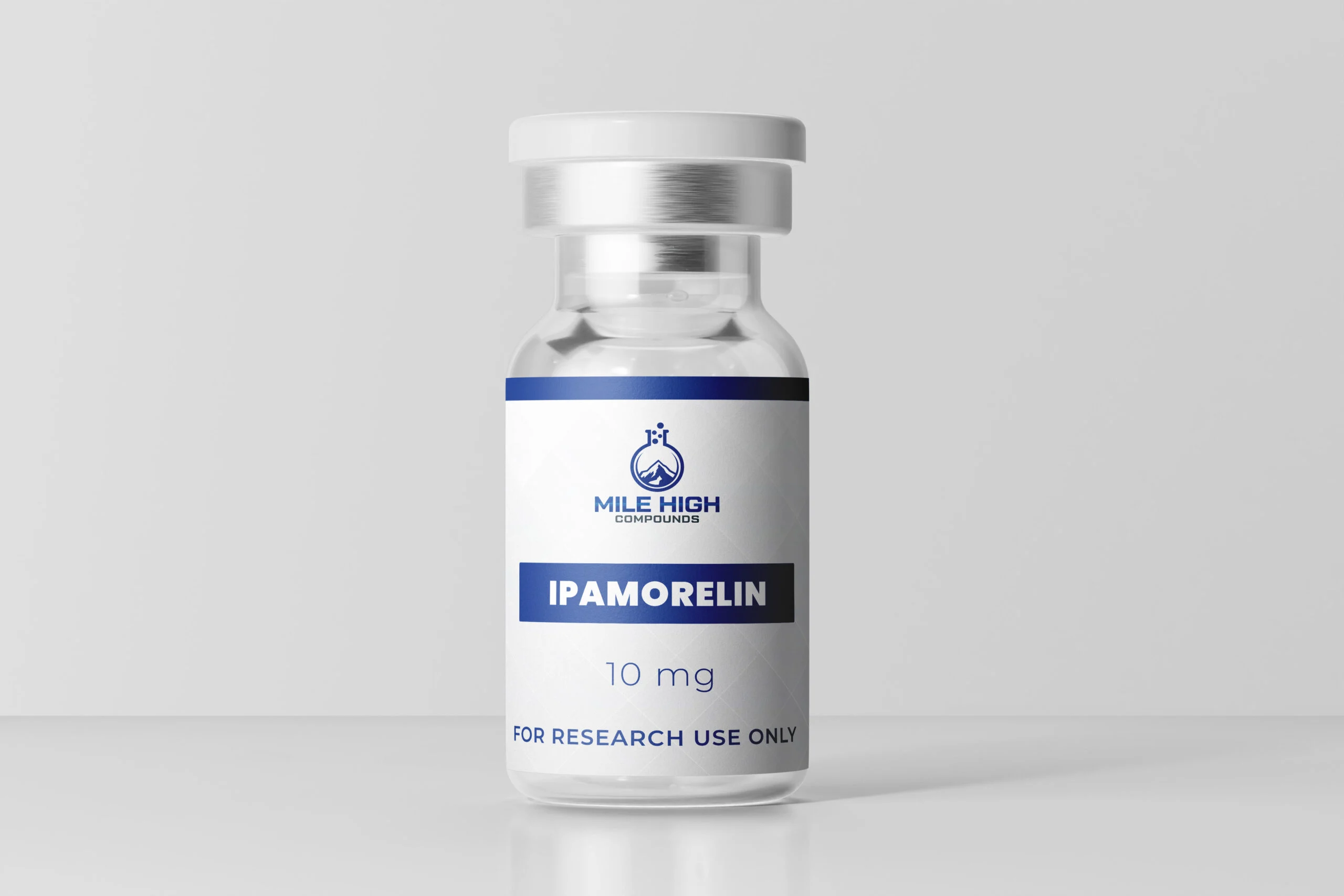
Ipamorelin: 7 Essential Facts About Growth Hormone Research and Safety
Ipamorelin is a synthetic peptide studied for its ability to stimulate the release of growth hormone (GH). It belongs to the growth hormone-releasing peptide family and has attracted scientific interest in endocrinology, metabolic regulation, and gastrointestinal research. However, its biological activity should not be confused with proven benefits for bodybuilding, fat loss, recovery, or healthy aging.
At Mile High Compounds, our goal is to provide science-driven information that distinguishes published research from unverified claims. This guide examines ipamorelin’s mechanism, available evidence, potential risks, and regulatory status.
1. What Is Ipamorelin?
this is a synthetic pentapeptide, meaning it contains five amino acids. Researchers developed it as a growth hormone secretagogue, a substance that stimulates the body to release growth hormone.
Unlike administering growth hormone directly, it acts on signaling pathways involved in the body’s natural hormone-release process. Its effects have been investigated in experimental and clinical settings, although the available research does not establish it as a safe or effective treatment for general wellness or performance enhancement.
this is sometimes discussed alongside other growth hormone secretagogues, including GHRP-2 and GHRP-6. These substances share aspects of their biological activity, but their effects and safety profiles should not be assumed to be identical.
2. How Does Ipamorelin Work?
it acts as an agonist of the growth hormone secretagogue receptor, commonly called GHS-R1a. This receptor is associated with ghrelin signaling and plays a role in regulating growth hormone secretion.
When the receptor is activated, signaling pathways can stimulate the pituitary gland to release growth hormone. Growth hormone, in turn, influences the production of insulin-like growth factor 1 (IGF-1), a hormone involved in growth and tissue metabolism.
A human pharmacokinetic and pharmacodynamic study published in 1999 found that intravenous ipamorelin stimulated growth hormone release in healthy male volunteers. The researchers also documented its concentration profile and the timing of the hormonal response. <Cite refs={[“turn658177search2”]}/>
These findings demonstrate biological activity under the conditions studied. They do not, by themselves, demonstrate improved physical performance, longevity, or clinical outcomes.
3. What Does Scientific Research Say About Ipamorelin?
The scientific literature includes early human investigations and research into possible medical applications. One area of interest has been postoperative ileus, a condition in which normal intestinal movement slows or stops after surgery.
Researchers investigated whether it could help address this complication. However, evidence from a limited clinical development program does not establish the peptide as a standard, approved treatment.
Research findings must be evaluated according to study design, sample size, outcome measures, and whether independent studies reproduce the results. Evidence of a change in hormone levels is not equivalent to evidence of meaningful long-term health benefits.
For claims about muscle development, body composition, exercise recovery, or anti-aging, robust clinical evidence demonstrating reliable benefits and acceptable long-term safety remains insufficient.
4. Potential Benefits: Claims Versus Evidence
It is frequently discussed online in connection with several proposed benefits. These claims require careful interpretation.
- Growth hormone release: Early human research supports an effect on growth hormone secretion under specific experimental conditions.
- Muscle growth: Hormonal activity alone does not establish that it improves muscle size or strength in healthy people.
- Fat loss: There is insufficient high-quality evidence to establish it as an effective weight-management treatment.
- Recovery and tissue repair: These applications require appropriate clinical trials; they cannot be inferred from its mechanism alone.
- Anti-aging: No established evidence demonstrates that it slows human aging or extends lifespan.
Mile High Compounds encourages readers to distinguish proposed mechanisms from proven clinical outcomes and to be cautious about testimonials that lack controlled evidence.
5. Ipamorelin Safety and Potential Side Effects
it’s safety profile is not sufficiently characterized for unsupervised use, particularly over extended periods. The FDA has identified concerns involving the potential for peptide aggregation, impurities, and immunogenicity with compounded ipamorelin acetate. It has also noted serious adverse events, including deaths, reported in a study involving intravenous administration for gastrointestinal motility. These reports warrant caution but do not establish that every route of administration carries identical risks. <Cite refs={[“turn658177search0″,”turn658177search23”]}/>
Because it stimulates the growth hormone and IGF-1 pathways, potential concerns may also include effects associated with elevated activity in these pathways. The FDA has discussed risks associated with growth hormone and IGF-1, including changes in glucose regulation and fluid retention, while noting that adequate data are lacking to determine it’s specific risk profile.
Other important uncertainties include long-term effects, immune reactions, product purity, contamination, and the reliability of products sold outside regulated clinical settings.
Anyone experiencing concerning symptoms after exposure should seek medical advice. A qualified healthcare professional can assess individual risks and possible complications.
6. Is Ipamorelin FDA Approved?
This is not an FDA-approved drug for bodybuilding, fat loss, anti-aging, or general wellness. Its appearance in scientific literature does not mean that regulators have established its safety, effectiveness, or manufacturing quality for these uses.
The FDA has identified ipamorelin acetate as a substance associated with significant safety concerns in certain compounding contexts. Compounded medications are not FDA-approved, and the agency does not review them for safety, effectiveness, and quality before marketing in the same way it reviews approved drugs. <Cite refs={[“turn658177search0″,”turn658177search1”]}/>
Regulatory rules vary by country and can change. Consumers should verify the applicable requirements and avoid assuming that a product labeled “research use” is suitable for human consumption.
7. Ipamorelin: Key Research Takeaways
This is an important example of why biological activity and clinical usefulness must be evaluated separately. Human research has demonstrated that it can stimulate growth hormone release under studied conditions, but evidence remains inadequate to support many broader claims associated with it.
Key points to remember:
- This is a synthetic five-amino-acid peptide.
- It acts on a receptor involved in growth hormone secretion.
- Early human research demonstrates hormonal activity, not comprehensive therapeutic benefits.
- Long-term safety and the effectiveness of commonly promoted wellness uses are not established.
- Regulatory and manufacturing concerns make product quality and medical oversight important considerations.
For researchers and readers exploring peptide science, the most reliable approach is to prioritize peer-reviewed studies, transparent safety information, and current regulatory guidance.
Frequently Asked Questions About Ipamorelin
What is ipamorelin used for?
It has been investigated as a growth hormone secretagogue and for possible medical applications, including postoperative gastrointestinal complications. It is not an FDA-approved treatment for general wellness or bodybuilding.
Does ipamorelin increase growth hormone?
A controlled early human study found that it stimulated growth hormone release under the experimental conditions tested. The result does not establish long-term clinical benefits.
Does ipamorelin help build muscle or burn fat?
High-quality evidence is insufficient to establish reliable muscle-building or fat-loss benefits in humans.
Is ipamorelin safe?
Its full safety profile, especially with prolonged use and unapproved products, remains uncertain. The FDA has raised concerns about compounded ipamorelin acetate, including immunogenicity, peptide impurities, and serious adverse events reported with intravenous administration.
Is ipamorelin FDA approved?
No. This is not FDA-approved for bodybuilding, anti-aging, fat loss, or general wellness.
Conclusion
This remains a subject of scientific interest because of its effect on growth hormone secretion. However, its clinical benefits, long-term safety, and suitability for commonly promoted uses have not been established. Understanding the difference between preliminary research and proven treatment is essential when evaluating this peptide.
Educational disclaimer: This article is for informational and educational purposes only and is not medical advice. It does not recommend human use of research chemicals or replace consultation with a qualified healthcare professional. Always consult current scientific literature and applicable regulatory guidance.

Reviews
There are no reviews yet.