
Semax/Selank/Pinealon Blend Spray: 7 Essential Facts About Brain Research and Safety
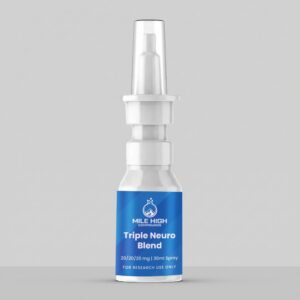
Semax/Selank/Pinealon Blend Spray is a combination of three experimental peptides associated with research into neurological signaling, stress-related responses, and cellular biology. The blend brings together Semax, Selank, and Pinealon, compounds that have been investigated separately for different proposed biological effects.
Interest in these peptides has grown in nootropic and wellness communities, but combining research compounds does not automatically produce greater benefits. The three-peptide formulation has not been established as a safe or effective treatment through controlled clinical trials.
This guide from Mile High Compounds explores the individual peptides, the limits of current evidence, nasal formulation considerations, and important safety questions.
1. What Is the Semax/Selank/Pinealon Blend?
This blend is marketed as a nasal spray containing three synthetic peptides:
- Semax: A seven-amino-acid peptide derived from a fragment of adrenocorticotropic hormone (ACTH), investigated for neurological and neuroprotective effects.
- Selank: A synthetic peptide related to tuftsin, studied primarily in research involving anxiety-related responses and neurological signaling.
- Pinealon: A short peptide commonly described as a bioregulator and investigated in experimental research involving cellular and neurological processes.
Each peptide has a distinct structure and research history. Their proposed mechanisms and evidence levels are not interchangeable.
The exact composition of a commercial blend can vary. Without independently verified product information, the stated ingredients, relative amounts, purity, and stability cannot be assumed to be consistent across products.
2. What Is Semax Studied For?
Semax has been investigated for its possible effects on neurological signaling, neuroprotection, and processes associated with neuronal function.
Some preclinical studies have examined pathways involving brain-derived neurotrophic factor (BDNF), a protein involved in neuronal survival and plasticity. Russian clinical literature has also explored Semax in certain neurological settings.
However, these findings do not establish that Semax reliably improves concentration, memory, or productivity in healthy people. Evidence from a particular clinical setting cannot automatically be generalized to cognitive enhancement.
The quality and scope of available studies also matter. More independently replicated research is needed to establish effectiveness and characterize safety across different populations and formulations.
3. What Is Selank Studied For?
Selank is a synthetic peptide derived from a tuftsin-related sequence. Research has examined its possible effects on anxiety-related behavior, stress responses, and neurological signaling.
Some human research has been published in Russia, but the evidence remains limited compared with the clinical evidence required to establish a treatment under widely used international standards.
A key distinction is that research on Selank alone does not demonstrate that it works the same way when combined with Semax and Pinealon. The interaction between multiple peptides may differ from the activity of each compound individually.
Claims that Selank reliably promotes calmness, balances mood, or improves mental performance should therefore be treated as unproven for this three-peptide blend.
4. What Is Pinealon and Why Is It Included?
Pinealon is a short peptide commonly described in experimental literature as a bioregulator. It has been discussed in relation to cellular regulation, oxidative processes, and neurological research.
Much of the available evidence is preclinical, meaning it comes from laboratory experiments or animal models rather than rigorous clinical studies in humans.
These early findings can help researchers formulate hypotheses, but they cannot establish that Pinealon improves memory, protects the brain, slows aging, or enhances the effects of other peptides.
There is also insufficient evidence to determine how Pinealon interacts with Semax and Selank when all three are present in one formulation. Any claim that the combination offers complementary or synergistic benefits requires direct testing.
5. Has the Three-Peptide Blend Been Clinically Tested?
The combined Semax/Selank/Pinealon formulation has not been established as safe or effective through controlled clinical trials.
Studies of individual ingredients cannot substitute for trials of the actual blend. Combining several compounds introduces additional questions about interactions, exposure, formulation stability, and adverse effects.
Important unanswered questions include:
- Whether all three peptides remain stable in the same formulation.
- Whether the ingredients interact with one another during storage or administration.
- How much of each compound is delivered and absorbed.
- Whether combining the peptides changes their individual effects or risks.
- Whether any reported benefits translate into meaningful outcomes in humans.
Without direct evidence, the blend should not be described as a proven nootropic, anxiety treatment, neuroprotective therapy, or cognitive-enhancement product.
6. What Should Consumers Know About Nasal Delivery and Safety?
Nasal delivery is used for some medicines and experimental compounds, but a nasal spray is not automatically effective or safe. Absorption depends on the formulation, peptide stability, delivery device, and condition of the nasal tissues.
The safety of this particular combination is not established. Potential concerns include local irritation, unexpected reactions, uncertain systemic exposure, and the possibility of impurities or inconsistent product composition.
The U.S. Food and Drug Administration has identified potential immunogenicity concerns for compounded Semax and Selank acetate preparations, including risks associated with peptide aggregation and peptide-related impurities. These concerns do not prove that every formulation causes harm, but they underscore why product quality and clinical safety data matter.
Semax, Selank, and Pinealon should not be assumed to be FDA-approved ingredients for this combined product. Consumers should not interpret online availability or a research label as evidence of regulatory approval, quality, or suitability for human use.
Anyone considering an experimental peptide product should consult a qualified healthcare professional, particularly if taking medication or managing a medical condition.
7. What Does Future Research Need to Establish?
Further research would need to evaluate the three peptides individually and as a combination.
Important priorities include confirming the blend’s composition, assessing formulation stability, investigating absorption and interactions, and conducting appropriate safety studies. Well-designed human trials would then be required to determine whether the combination offers any meaningful benefit.
Researchers would also need to establish whether the three peptides produce additive effects, interfere with one another, or introduce risks that are not apparent when the compounds are studied separately.
Until these questions are answered, the Semax/Selank/Pinealon Blend Spray remains an experimental combination with substantial evidence gaps.
Frequently Asked Questions About Semax/Selank/Pinealon Blend Spray
What is Semax/Selank/Pinealon Blend Spray?
It is a nasal formulation marketed as containing Semax, Selank, and Pinealon, three experimental peptides investigated separately for different neurological and cellular effects.
Does the three-peptide blend improve memory and focus?
There is insufficient clinical evidence to establish that the combined formulation improves memory, concentration, or cognitive performance in humans.
Has the combination been tested in clinical trials?
The combination has not been established through controlled clinical trials. Findings from studies of individual peptides do not prove the effectiveness or safety of the blend.
Is the blend FDA-approved?
The three-peptide blend is not an FDA-approved treatment for cognitive enhancement, anxiety, or neurological disease.
Is Semax/Selank/Pinealon Blend Spray safe?
Its safety has not been adequately established. Questions remain about interactions, absorption, long-term effects, and the quality of commercial formulations.
Are Semax, Selank, and Pinealon the same type of peptide?
They are distinct peptides with different structures and research histories. Their proposed mechanisms and findings should be evaluated separately rather than treated as interchangeable.
Conclusion
Semax/Selank/Pinealon Blend Spray combines three peptides that have attracted research interest in neurological signaling and cellular biology. However, the available evidence for the individual compounds does not establish that the combined formulation is effective or safe for humans.
The most responsible approach is to distinguish preliminary laboratory findings from proven clinical outcomes, verify product composition, and avoid unsupported claims about cognitive enhancement or treatment of medical conditions.
Mile High Compounds encourages transparent product information and evidence-based discussion of experimental compounds.
Educational disclaimer: This article is for informational and educational purposes only. It is not medical advice and does not establish the safety or effectiveness of Semax/Selank/Pinealon Blend Spray for human use.


Reviews
There are no reviews yet.