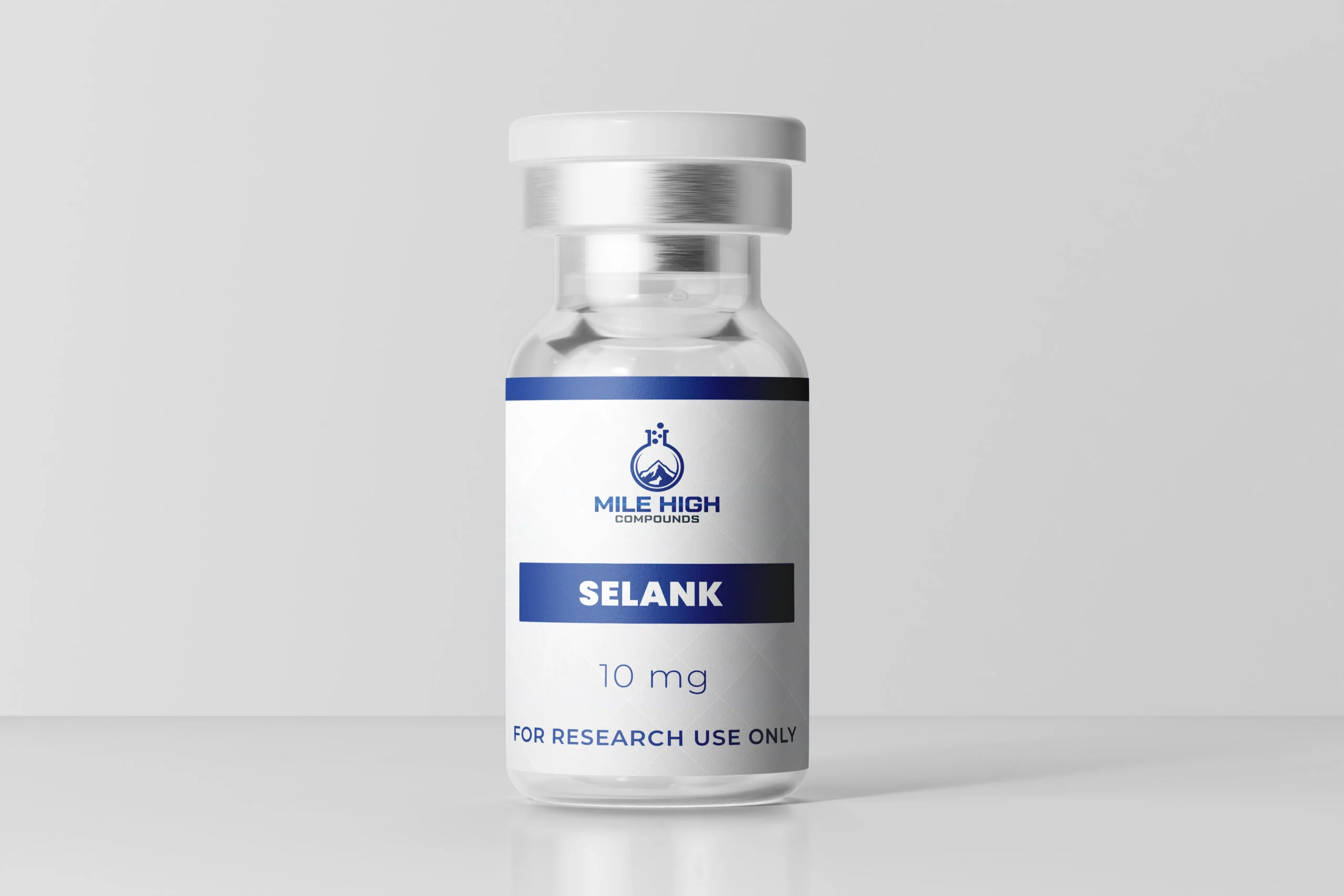
Selank: 7 Essential Facts About Peptide Research and Safety
1. What Is Selank?
Selank is a synthetic heptapeptide, meaning it consists of seven amino acids. Its amino acid sequence is commonly identified as Thr-Lys-Pro-Arg-Pro-Gly-Pro. Researchers developed Selank based on tuftsin, a naturally occurring peptide fragment associated with immune function, by adding a short sequence intended to influence its stability.
It has attracted scientific interest primarily because of its proposed effects on anxiety-related processes, stress responses, and neurological signaling. It is also marketed online as a nootropic, a term commonly used for substances promoted for cognitive performance. However, commercial descriptions should not be confused with established clinical benefits.
At Mile High Compounds, our goal is to provide science-driven information that helps readers understand peptide research, potential applications, and the limitations of current evidence.
2. Essential Facts About Selank Peptide Research
This has been investigated in laboratory experiments, animal models, and a limited number of human studies. Much of the published clinical literature originated in Russia.
Researchers have explored several possible biological mechanisms, including interactions with pathways associated with gamma-aminobutyric acid (GABA), enkephalin metabolism, and the regulation of stress-related responses. These pathways are relevant to neurological function, but the precise mechanisms responsible for it’s reported effects remain incompletely understood.
An important principle in peptide research is that a plausible biological mechanism does not automatically establish a treatment’s effectiveness. Findings from laboratory experiments may guide further research, but controlled human studies are needed to determine whether a compound produces meaningful benefits and whether those benefits outweigh its risks.
3. Selank and Anxiety Research
One of the main areas of interest in it research is its potential relationship with anxiety-related symptoms.
A 2008 clinical study indexed in PubMed compared it with medazepam in 62 patients with generalized anxiety disorder and neurasthenia. The researchers reported improvements in anxiety-related measures, but the study was relatively small and did not establish effectiveness through a large, independently replicated clinical program. <Cite refs={[“turn223271search2”]}/>
A separate 2014 study compared it with phenazepam in 60 patients with anxiety-related and somatoform disorders. The authors reported an anxiolytic effect, but this study also had a limited sample size and does not provide the same level of evidence as a large, modern, placebo-controlled clinical trial. <Cite refs={[“turn223271search0”]}/>
These findings explain why it continues to attract scientific interest. Nevertheless, they should be interpreted cautiously. Small studies, differences in research methods, and limited independent replication make it difficult to draw firm conclusions about effectiveness in broader populations.
Selank should not be considered an established substitute for evidence-based mental health care.
4. Selank, Cognitive Function, and Neurological Signaling
This is frequently marketed as a cognitive-enhancement peptide. Researchers have investigated whether its biological activity may influence processes associated with stress, attention, memory, and neurological signaling.
Some preclinical research has examined changes in neurotransmitter-related pathways and behavioral responses in animals. These studies may help researchers formulate hypotheses about how the peptide works, but animal findings cannot establish that it improves memory, concentration, productivity, or cognitive performance in humans.
There is also insufficient high-quality evidence to determine whether it offers consistent cognitive benefits for healthy adults. Claims that it reliably improves focus, prevents cognitive decline, or enhances intellectual performance should therefore be treated as unproven.
Future research would need to evaluate specific cognitive outcomes using validated assessments, appropriate comparison groups, and sufficient follow-up periods.
5. Selank Safety, Purity, and Regulatory Status
Safety is an important consideration when evaluating the products. this is not FDA-approved as a drug in the United States. Its availability through online sellers does not establish that a product has undergone regulatory review for safety, effectiveness, or manufacturing quality.
The FDA has identified potential concerns regarding compounded it acetate, including the possibility of immunogenicity associated with peptide aggregation and peptide-related impurities. The agency has also noted that important human safety information is lacking. <Cite refs={[“turn223271search13″,”turn223271search24”]}/>
Immunogenicity refers to the possibility that a substance may trigger an immune response. The likelihood and consequences of such a response can depend on the substance, formulation, impurities, and route of administration.
Other important uncertainties include long-term effects, interactions with medications, product consistency, and the reliability of products sold outside regulated pharmaceutical channels. Research findings from one formulation cannot automatically be applied to another.
Anyone considering an experimental peptide for a health concern should consult a qualified healthcare professional rather than relying on seller claims or online testimonials.
6. Understanding the Limitations of Selank Research
Although it has a published research history, several evidence gaps remain.
- Limited clinical evidence: Existing human studies are relatively small and do not establish broad effectiveness.
- Independent replication: Findings need confirmation through well-designed studies conducted by independent research teams.
- Long-term safety: Available evidence does not adequately establish the long-term safety profile.
- Mechanism of action: Proposed neurological pathways require further investigation.
- Product quality: Research on a defined compound does not verify the identity, purity, sterility, or consistency of every commercial product.
These limitations are especially important when evaluating claims about anxiety relief, cognitive enhancement, or general wellness. A scientific hypothesis is a starting point for investigation, not proof of a clinical outcome.
Stronger evidence would require appropriately designed clinical trials, transparent reporting of adverse events, standardized product characterization, and longer-term follow-up.
7. Frequently Asked Questions About Selank
What is Selank used for in research?
This is primarily investigated for possible effects on anxiety-related processes, stress responses, and neurological signaling. Its clinical effectiveness remains uncertain.
Is Selank FDA-approved?
No. it is not FDA-approved as a drug in the United States. Products marketed online should not be assumed to be approved medications.
Does Selank improve memory or focus?
There is insufficient high-quality human evidence to establish reliable improvements in memory, focus, or cognitive performance.
What is the difference between Selank and Semax?
This is derived from the tuftsin peptide family and is primarily studied in anxiety-related research. Semax is derived from a fragment of adrenocorticotropic hormone (ACTH) and has been investigated in different neurological contexts. They are distinct peptides, and evidence about one cannot automatically be applied to the other.
Is Selank’s long-term safety established?
No. Available evidence is insufficient to establish long-term safety, and concerns about formulation quality, impurities, and potential immune responses remain relevant.
Conclusion: Making Informed Decisions About Selank
This is an experimental peptide with a history of research into anxiety-related biology and neurological signaling. Some small clinical studies have reported potentially interesting findings, but the available evidence is not sufficient to establish broad clinical effectiveness or long-term safety.
Understanding the difference between preliminary findings and established medical evidence is essential when evaluating it. Mile High Compounds encourages readers to prioritize credible scientific research, transparent product information, and qualified medical guidance over unsupported claims.
Educational disclaimer: This article is for informational and educational purposes only. It does not provide medical advice, diagnose or treat any condition, or recommend the use of it. Consult a qualified healthcare professional about health concerns and treatment decisions.



Reviews
There are no reviews yet.