
Acetic Acid: 7 Essential Facts About Chemical Uses and Safety
Acetic acid is a widely used chemical found in vinegar, food processing, laboratory environments, and industrial manufacturing. Also known as ethanoic acid, it is a simple organic acid with the chemical formula CH₃COOH. Its applications range from pH adjustment and preservation to chemical synthesis and analytical research.
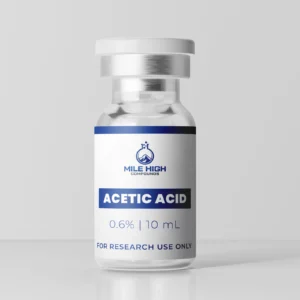
For anyone researching acetic acid through Mile High Compounds, understanding its chemical properties, grades, applications, and safety requirements is essential. Although dilute, food-grade acetic acid is used in certain foods, concentrated acetic acid can cause serious burns and other injuries. Its suitability depends on its concentration, purity, formulation, and intended application. <Cite refs={[“turn850528search0″,”turn850528search2″,”turn850528search4”]} />
1. What Is Acetic Acid?
This is a colorless organic compound with a characteristic sharp, vinegar-like odor. Its molecular formula is CH₃COOH, and its CAS Registry Number is 64-19-7.
It is classified as a carboxylic acid because its molecular structure contains a carboxyl group. In aqueous solutions, it can release hydrogen ions, making the solution acidic. This property explains its usefulness in pH adjustment, chemical reactions, and food preservation.
Acetic acid occurs in vinegar, which typically contains a relatively low concentration of the compound in water. Nearly pure acetic acid is commonly called glacial acetic acid. Despite sharing the same chemical identity, dilute solutions and concentrated material have substantially different handling requirements.
2. Important Chemical Properties
This is miscible with water, meaning it can mix with water in all proportions. It has a molecular weight of approximately 60.1 g/mol and a boiling point of about 118°C under standard atmospheric pressure. Pure acetic acid freezes at approximately 16.6°C, which explains the term “glacial” when crystals form under cool conditions. <Cite refs={[“turn850528search0″,”turn850528search3”]} />
Its acidity and solvent-related properties make it useful in many chemical processes. However, the behavior of an acetic acid solution depends on concentration, temperature, and the materials with which it comes into contact.
Concentrated acetic acid is corrosive and combustible. Its vapors can irritate the eyes and respiratory tract, while direct contact can cause serious skin or eye injuries. Appropriate storage and handling procedures are therefore essential.
3. Common Applications of Acetic Acid
It serves several purposes across different industries.
- Food production: Food-grade acetic acid may be used as an acidity regulator, flavoring agent, or preservative in accordance with applicable food regulations.
- Laboratory research: It can serve as a reagent or pH-adjusting chemical in analytical and experimental procedures.
- Chemical manufacturing: It is used in the production of various chemicals, plastics, dyes, and other industrial materials.
- Cleaning applications: Certain formulated products use acetic acid to help remove mineral deposits and scale.
- Industrial processing: It is used in selected manufacturing operations where controlled acidity is required.
These applications require different specifications. A product suitable for food manufacturing is not automatically suitable for every laboratory procedure, and an industrial-grade chemical should not be assumed appropriate for food, cosmetic, or medical use. <Cite refs={[“turn850528search2″,”turn850528search4″,”turn850528search7”]} />
4. Understanding Acetic Acid Grades
Chemical grade is an important consideration when evaluating acetic acid. Labels such as food grade, reagent grade, and industrial grade refer to different quality requirements and intended applications.
Food-grade acetic acid must meet applicable purity specifications and be used according to relevant food regulations. The US Food and Drug Administration recognizes acetic acid for specified food uses when it meets suitable purity requirements and is used in accordance with good manufacturing practices. <Cite refs={[“turn850528search2″,”turn850528search12”]} />
Reagent-grade acetic acid is intended for laboratory applications requiring defined chemical specifications. The appropriate grade depends on the analytical method or experiment.
Industrial-grade acetic acid is manufactured for particular production and processing requirements. Its specifications may not meet the standards needed for food, pharmaceutical, or specialized laboratory applications.
Always review the product label, certificate of analysis when available, safety data sheet, and manufacturer’s specifications before selecting a chemical.
5. Acetic Acid in Laboratory and Chemical Research
In laboratory environments, it may be used to adjust solution acidity, support chemical reactions, or prepare reagents for specific analytical procedures.
Reliable research depends on controlling variables such as concentration, purity, storage conditions, and compatibility with other materials. Researchers should follow a validated protocol rather than assuming that every acetic acid product can be substituted for another.
An important distinction applies to pharmaceutical and peptide-related research. Ordinary acetic acid is not automatically a suitable ingredient for sterile preparations, injections, or other applications requiring stringent pharmaceutical quality controls. Food-grade or laboratory-grade labeling alone does not establish sterility or suitability for human administration.
For specialized research, the selected material must meet the requirements of the particular method and intended use.
6. Safety, Storage, and Handling
It safety depends strongly on concentration. Dilute solutions used in food products have a different hazard profile from concentrated or glacial acetic acid.
The US National Institute for Occupational Safety and Health identifies eye, skin, and respiratory irritation as important hazards and warns that contact with stronger solutions can cause burns. <Cite refs={[“turn850528search0″,”turn850528search8”]} />
Key precautions include:
- Read the product’s safety data sheet before use.
- Wear appropriate chemical-resistant gloves and eye protection.
- Use suitable ventilation when handling products that may release irritating vapors.
- Keep containers properly labeled and tightly closed.
- Store the chemical according to the manufacturer’s instructions, away from incompatible materials and ignition sources.
- Never mix chemicals without verifying compatibility and following an established procedure.
If it contacts the eyes or skin, begin immediate flushing with plenty of water and obtain appropriate medical advice. For significant exposure, inhalation difficulties, or suspected ingestion of concentrated acid, seek urgent medical or poison-control assistance. Do not attempt to neutralize a chemical burn on the body.
7. Choosing and Evaluating an Acetic Acid Product
Selecting it starts with identifying the exact application. Food production, laboratory testing, industrial processing, and specialized research may require different concentrations and quality standards.
Review the concentration, stated grade, manufacturer, batch identification, storage requirements, and safety documentation. Where appropriate, a certificate of analysis can help verify whether a product meets its stated specifications.
Avoid relying solely on price or a broad description such as “pure acetic acid.” Such wording does not necessarily confirm that the product meets the requirements of a particular application.
For Mile High Compounds readers, the central principle is straightforward: choose materials according to verified specifications, use them only for their intended purpose, and follow the relevant safety and regulatory requirements.
Frequently Asked Questions
What is acetic acid used for?
It is used in food processing, pH adjustment, laboratory research, chemical manufacturing, cleaning formulations, and other industrial applications.
Is acetic acid the same as vinegar?
No. Vinegar is a mixture that contains water and acetic acid, usually at a relatively low concentration, along with other components. Diluted acetic acid is not automatically equivalent to vinegar. <Cite refs={[“turn850528search2″,”turn850528search4”]} />
Is acetic acid safe?
Its safety depends on concentration, purity, exposure route, and intended use. Food-grade material can be used in permitted food applications, while concentrated acetic acid can cause severe burns and respiratory irritation.
What does glacial acetic acid mean?
Glacial it refers to nearly pure acetic acid. It is substantially more hazardous to handle than the dilute solutions commonly found in vinegar.
Can any grade of acetic acid be used for laboratory or pharmaceutical research?
No. The appropriate specifications depend on the procedure. Food-grade and reagent-grade products should not be assumed sterile or suitable for pharmaceutical preparations or human administration.
Conclusion
This is a versatile organic chemical with important roles in food processing, laboratories, and industrial manufacturing. Its usefulness comes from its chemical properties, but safe and effective application requires careful attention to concentration, grade, purity, and handling.
Understanding these distinctions helps researchers and buyers evaluate products responsibly and select materials that meet the requirements of their intended applications.
Educational disclaimer: This article is for informational and chemical-education purposes only. It is not medical advice or a substitute for a product safety data sheet, validated laboratory procedures, or applicable regulatory guidance. This should only be handled and used in accordance with its specifications and safety requirements.


Reviews
There are no reviews yet.