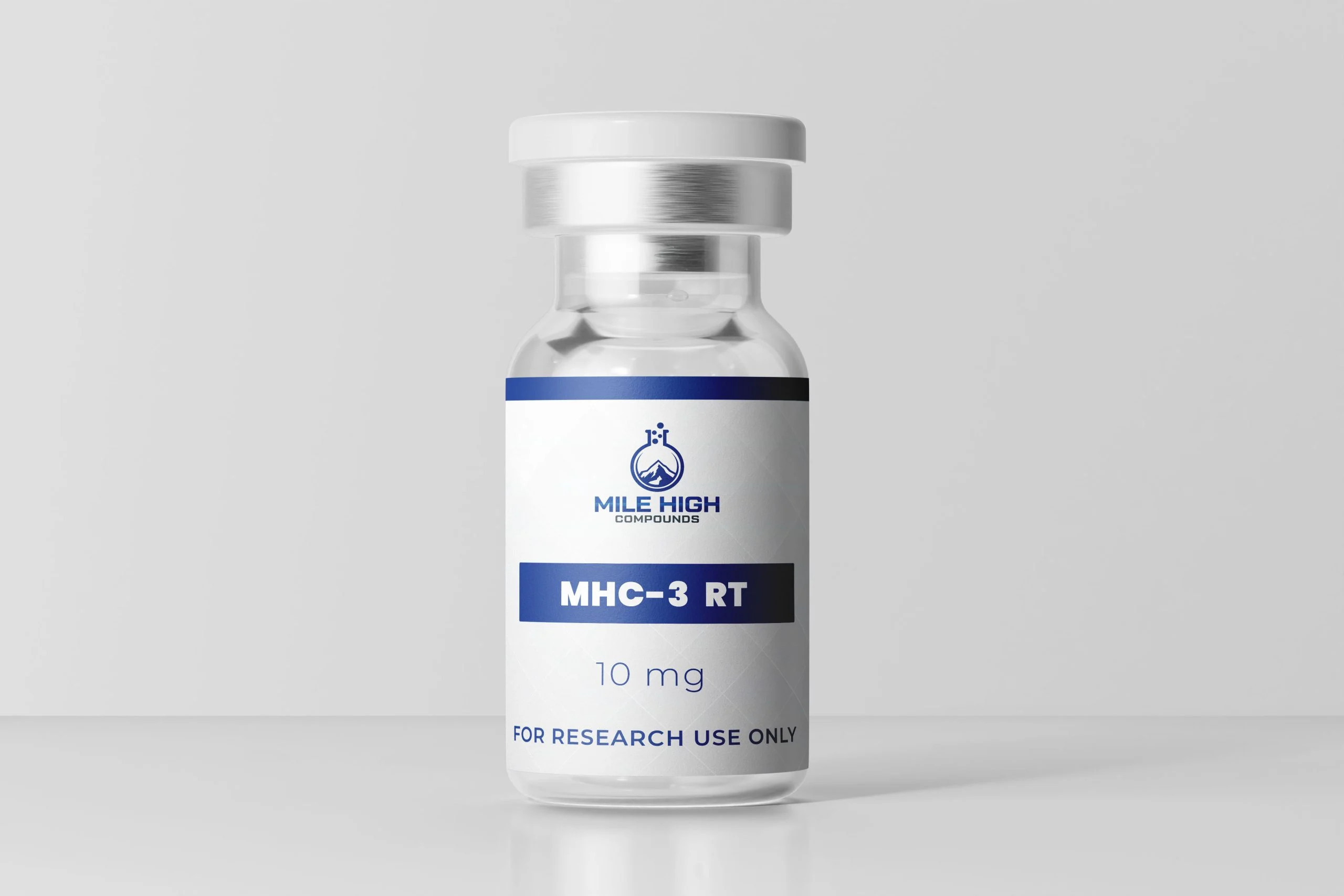
MHC-3 RT: 7 Essential Facts About Retatrutide Research and Safety
MHC-3 RT is a vendor code name associated with retatrutide, an investigational triple-hormone receptor agonist being studied for obesity and metabolic health. Retatrutide has attracted scientific interest because it activates three receptors involved in energy regulation: glucose-dependent insulinotropic polypeptide (GIP), glucagon-like peptide-1 (GLP-1), and glucagon receptors. However, a vendor label alone cannot confirm the identity or quality of a specific product. Clinical research and regulatory information should guide an accurate understanding of this compound. <Cite refs={[“turn260373search2″,”turn358898search4”]}/>
Mile High Compounds — Your source for research compounds, peptide information, and science-driven insights.
1. What Is MHC-3 RT?
MHC-3 RT is the product name used by a supplier for retatrutide. Retatrutide is also known by its development identifier, LY3437943, and is being investigated as a potential treatment for obesity and related metabolic conditions. <Cite refs={[“turn260373search0″,”turn358898search4”]}/>
It is important to distinguish a vendor’s product code from a scientifically verified compound identity. A product name, label, or certificate of analysis (COA) does not independently prove that a vial contains the expected substance or that it is suitable for use in humans.
Retatrutide is an investigational drug, not an established, FDA-approved treatment. Products marketed under research labels should not be assumed to have the same quality, safety, or evidence base as products evaluated through formal clinical development.
2. How Does Retatrutide Work?
Retatrutide is described as a triple receptor agonist because it activates three hormone receptors involved in metabolic regulation:
- GLP-1 receptor: Participates in appetite regulation, glucose control, and insulin secretion in response to meals.
- GIP receptor: Helps regulate nutrient-related hormone responses and glucose metabolism.
- Glucagon receptor: Plays a role in energy metabolism and the regulation of glucose and fat utilization.
Researchers are studying whether engaging these three pathways together may produce meaningful changes in body weight and metabolic outcomes. The combined mechanism is scientifically interesting, but the presence of multiple receptor targets does not automatically establish superior safety or effectiveness for every patient. <Cite refs={[“turn358898search4″,”turn358898search2”]}/>
3. What Does Clinical Research Say About MHC-3 RT?
Research on retatrutide has progressed beyond laboratory experiments into human clinical trials.
A Phase 2 randomized trial published in The New England Journal of Medicine in 2023 enrolled 338 adults with obesity or overweight and a weight-related condition. At 48 weeks, average weight changes ranged from approximately 8.7% to 24.2% across the retatrutide treatment groups, compared with approximately 2.1% with placebo. These results were observed under controlled trial conditions and should not be interpreted as a guaranteed individual outcome. <Cite refs={[“turn358898search4″,”turn358898search12”]}/>
In September 2026, a Phase 3 study published in the same journal reported significant reductions in body weight among adults with obesity without diabetes. Gastrointestinal events were among the most common adverse events. <Cite refs={[“turn358898search2″,”turn358898search3”]}/>
These findings are important, but research results apply to the specific formulation, participants, monitoring, and procedures used in each trial. They do not establish that an independently sold product labeled MHC-3 RT has equivalent quality or effects.
4. What Are the Potential Research Applications?
Researchers are investigating retatrutide primarily for obesity and metabolic conditions. Clinical studies have also evaluated outcomes involving knee osteoarthritis symptoms and obstructive sleep apnea in people with obesity. <Cite refs={[“turn358898search2″,”turn358898search8”]}/>
These are research areas rather than blanket claims that retatrutide treats every associated condition. Trial findings must be assessed individually, including the study population, measured outcomes, duration, and adverse events.
For educational and scientific content, the most accurate approach is to describe what investigators have studied rather than promise weight loss, disease prevention, or other health benefits.
5. What Are the Known and Potential Safety Concerns?
Gastrointestinal adverse events have been common in retatrutide clinical trials. Other safety considerations require continued evaluation as larger and longer studies produce more evidence. A favorable result for one outcome does not mean the compound is free of risks.
The safety of an unverified research product presents additional uncertainties, including possible misidentification, contamination, inaccurate content, storage problems, and inadequate sterility controls.
The U.S. Food and Drug Administration (FDA) states that retatrutide cannot be used in compounding under federal law and has warned against products sold to consumers under misleading research-only labels for human use. The agency also states that retatrutide has not been found safe and effective for any condition as an FDA-approved drug. <Cite refs={[“turn358898search0″,”turn358898search11”]}/>
Retatrutide should not be self-administered based on online descriptions or vendor instructions. Anyone considering treatment for obesity should discuss approved options and individual risks with a qualified healthcare professional.
6. How Should Researchers Evaluate Product Quality?
When assessing a research material, documentation should be reviewed critically. Useful quality information may include:
- Identity testing: Evidence that the tested material matches the stated compound.
- Purity testing: Analytical results identifying the proportion of material attributed to the target substance.
- Content verification: Measurement of the amount present in the tested sample.
- Contaminant testing: Relevant information on residual solvents, metals, and other impurities.
- Sterility and endotoxin testing: Especially important considerations for materials represented as sterile or intended for laboratory procedures where microbial contamination matters.
- Lot traceability: A clear connection between the report and the specific batch supplied.
A certificate of analysis can support quality assessment, but it is not a guarantee of clinical safety, regulatory approval, or suitability for human use. Its value depends on the laboratory, testing methods, sample traceability, and the results actually documented.
7. Is MHC-3 RT FDA Approved?
No. Retatrutide remains investigational and is not an FDA-approved medication. Clinical-trial progress does not itself constitute marketing authorization, and a research-use disclaimer does not make an unapproved drug suitable for human consumption. <Cite refs={[“turn358898search0″,”turn358898search2”]}/>
People seeking medical treatment should consult a licensed healthcare professional about approved therapies and whether participation in a properly authorized clinical trial is appropriate. Researchers should follow applicable institutional, laboratory, and regulatory requirements.
Frequently Asked Questions About MHC-3 RT
Is MHC-3 RT the same as retatrutide?
MHC-3 RT is associated with retatrutide as a vendor code name. The label alone does not independently verify the identity or quality of a particular sample. <Cite refs={[“turn260373search2″,”turn260373search0”]}/>
Is retatrutide a GLP-1 peptide?
Retatrutide activates GLP-1, GIP, and glucagon receptors, so it is more accurately described as a triple receptor agonist than as a GLP-1-only agent. <Cite refs={[“turn358898search4”]}/>
Has retatrutide been studied in humans?
Yes. Published Phase 2 and Phase 3 clinical research has investigated retatrutide, including weight-related outcomes. Clinical-trial evidence does not establish the safety or quality of every product sold under a vendor code. <Cite refs={[“turn358898search4″,”turn358898search2”]}/>
Is MHC-3 RT approved for weight loss?
No. Retatrutide is investigational and is not FDA-approved for weight loss. FDA guidance also states that retatrutide cannot be used in compounding under federal law. <Cite refs={[“turn358898search0”]}/>
Conclusion
MHC-3 RT is a vendor code associated with retatrutide, an investigational triple-hormone receptor agonist with promising clinical research findings and important remaining safety and regulatory considerations. Understanding its mechanism and clinical evidence requires separating controlled trial results from claims about unverified products.
For reliable research information, prioritize peer-reviewed studies, official clinical-trial records, transparent analytical documentation, and current regulatory guidance. This article is for educational purposes only and is not medical advice. The material discussed is not a recommendation to purchase, prepare, or administer an investigational compound to humans or animals.


Reviews
There are no reviews yet.