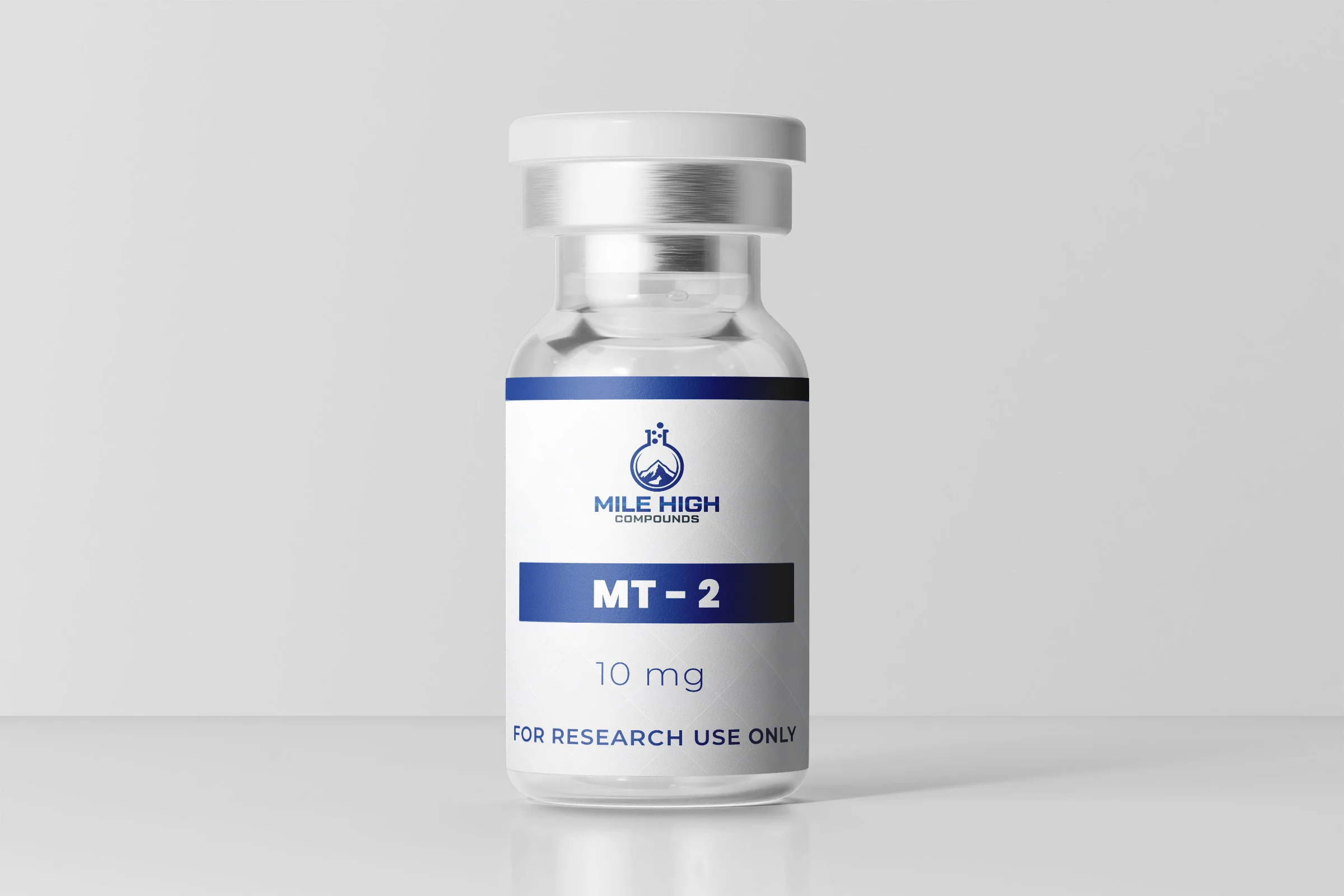
MT-2: 7 Essential Facts About Melanotan II Research and Safety
MT-2, also known as Melanotan II or MT-II, is a synthetic peptide studied for its effects on melanocortin receptors, which influence skin pigmentation and several other biological processes. It is commonly marketed online as a tanning peptide, but MT-2 is not approved by the U.S. Food and Drug Administration (FDA) for any medical use. Its safety, product quality, and long-term effects remain important concerns.
At Mile High Compounds, our goal is to provide educational information about research compounds, including their biological mechanisms, available evidence, regulatory status, and potential risks.
1. What Is MT-2?
This is a synthetic cyclic peptide developed to investigate the activity of melanocortin receptors. It is structurally related to alpha-melanocyte-stimulating hormone (α-MSH), a naturally occurring peptide involved in skin pigmentation and other physiological functions.
Unlike a cosmetic tanning lotion, it acts on biological receptors. This broader activity is one reason researchers have investigated effects beyond pigmentation, including appetite regulation and sexual function.
This is distinct from Melanotan I. Although the two compounds are related, they differ in their structure, receptor activity, and research history. They should not be treated as interchangeable products.
2. How Does MT-2 Work?
It activates multiple melanocortin receptors. These receptors participate in several physiological pathways:
- MC1R: Involved in melanin production and skin pigmentation.
- MC3R: Associated with energy balance and other metabolic processes.
- MC4R: Involved in appetite regulation and aspects of sexual function.
- Other melanocortin pathways: May contribute to additional biological effects.
Activation of it can stimulate melanin production, helping explain why it has been investigated for its pigmentation effects. However, its activity at multiple receptor types also means its effects are not limited to skin color.
This lack of receptor selectivity contributes to uncertainty about both intended effects and adverse reactions. Biological activity alone does not demonstrate that a compound is safe or effective for cosmetic or medical use. <Cite refs={[“turn631820search7″,”turn631820search2”]}/>
3. Why Is MT-2 Associated With Tanning?
This is widely discussed online because of its potential to increase skin pigmentation. It has been marketed as a way to obtain a darker appearance without relying exclusively on conventional tanning methods.
However, a darker skin tone does not establish that the skin is protected from ultraviolet radiation. it has not been demonstrated to provide reliable protection against sunburn or skin cancer, and it should not replace sunscreen, protective clothing, or other sun-safety measures.
Unregulated tanning products may also have inconsistent concentrations and uncertain ingredients. In August 2026, Australia’s Therapeutic Goods Administration reported laboratory testing that found substantially different estimated amounts of it across tested nasal-spray bottles, highlighting concerns about product consistency. <Cite refs={[“turn631820search0″,”turn631820search11”]}/>
For people seeking a tanned appearance, established cosmetic sunless-tanning products are a safer alternative to unapproved tanning peptides.
4. What Does Scientific Research Say About MT-2?
Research into it has examined melanocortin receptor activity, pigmentation, appetite, and sexual responses. Some early human observations suggested that the compound could influence pigmentation and cause physiological effects beyond those initially intended.
Nevertheless, the available evidence does not establish it as a safe, approved tanning treatment. Early or small studies cannot reliably establish long-term safety, and findings from laboratory experiments do not automatically translate into proven benefits in people.
Claims that it reliably improves body composition, enhances sexual performance, or offers health benefits should be treated cautiously. Evidence for one biological effect does not establish the safety or effectiveness of every marketed use.
The distinction between a research finding and an approved treatment is particularly important when evaluating compounds promoted through social media or online peptide vendors. <Cite refs={[“turn631820search7″,”turn631820search13”]}/>
5. Is MT-2 FDA Approved?
This is not FDA-approved for tanning, sexual enhancement, or any other medical indication in the United States. It has also not been authorized as a tanning agent by Australia’s Therapeutic Goods Administration or Ireland’s Health Products Regulatory Authority. Regulatory rules differ between jurisdictions, so local requirements should always be checked. <Cite refs={[“turn631820search1″,”turn631820search12”]}/>
Products sold online may be labeled for research purposes, but such labeling does not establish purity, sterility, safety, or suitability for human use.
Regulatory authorities have warned that unapproved products may contain incorrect concentrations, undisclosed ingredients, or contaminants. Buyers should not assume that professional-looking packaging or a supplier-provided certificate means a product has undergone the rigorous evaluation required for an approved medicine.
6. MT-2 Safety Risks and Reported Side Effects
MT-2 has been associated with several adverse effects, including nausea, flushing, headache, fatigue, appetite changes, and unwanted or prolonged erections. The frequency and severity of these effects are not reliably established for unregulated products.
Another major concern involves changes in moles and other pigmented skin lesions. Published case reports have described melanoma diagnoses following MT-2 use, but case reports cannot establish that the peptide directly caused those cancers. They nevertheless raise concerns because changes in pigmentation can complicate the recognition of suspicious lesions. <Cite refs={[“turn631820search1″,”turn631820search7”]}/>
Product quality creates additional risks, particularly when injectable materials have uncertain sterility or concentration. The absence of adequate long-term safety data means the full range of potential complications remains unknown.
People who have used MT-2 and notice a changing mole, unusual skin lesion, severe symptoms, or a prolonged erection should seek appropriate medical care. Anyone considering a tanning product should discuss health concerns with a qualified healthcare professional.
7. How to Evaluate MT-2 Research Information
Responsible research requires reliable sources and careful interpretation of evidence. When reviewing information about this, consider the following questions:
- Does the source distinguish animal or laboratory research from human clinical evidence?
- Are claims supported by peer-reviewed studies or authoritative regulatory guidance?
- Does the source clearly disclose that it is not an approved tanning medicine?
- Are adverse effects and uncertainties discussed alongside proposed benefits?
- Does the information avoid presenting unverified products as safe for human use?
These questions can help readers distinguish scientific information from unsupported marketing claims.
For researchers, accurate compound identification and appropriate laboratory safety procedures are essential. For consumers, the central issue is that MT-2 remains an unapproved substance with unresolved safety concerns. Research interest should not be mistaken for a recommendation to use it.
Frequently Asked Questions
What is MT-2?
MT-2, or Melanotan II, is a synthetic peptide that activates melanocortin receptors and has been investigated for effects on pigmentation and other physiological functions.
Is MT-2 the same as Melanotan I?
No. MT-2 and Melanotan I are related but distinct compounds with different structures and pharmacological profiles.
Is MT-2 FDA-approved?
No. MT-2 is not FDA-approved for tanning or any other medical use in the United States.
Does MT-2 protect against UV radiation?
Reliable protection against ultraviolet radiation has not been established. It should not replace sunscreen or other sun-protection measures.
Is MT-2 safe for long-term use?
Long-term safety has not been established. Unapproved products also carry additional risks involving uncertain ingredients, concentration, and quality.
Conclusion
MT-2 is a synthetic melanocortin peptide that has attracted attention because of its effects on pigmentation and other biological pathways. However, its broader receptor activity, reported adverse effects, uncertain long-term risks, and unregulated product supply raise significant safety concerns.
Understanding the difference between experimental research and established medical evidence is essential. MT-2 should not be presented as an approved tanning treatment or as a proven method for improving health or appearance.
Educational disclaimer: This article is for informational purposes only and is not medical advice. It does not recommend using MT-2 to diagnose, treat, cure, or prevent any disease. Consult a qualified healthcare professional for medical guidance.


Reviews
There are no reviews yet.