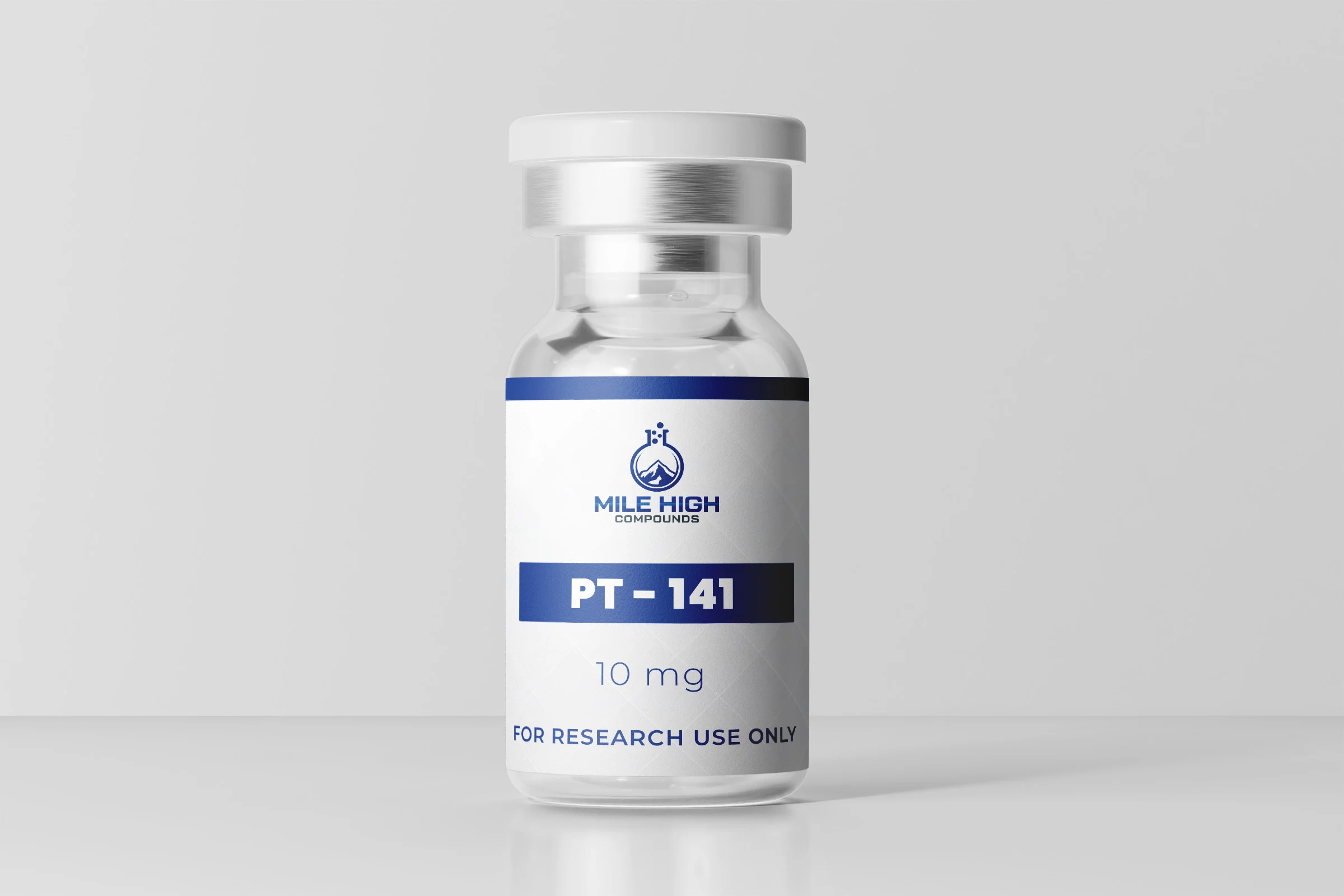
PT-141: 7 Essential Facts About Sexual Desire Research and Safety
PT-141 is a synthetic peptide researched for its effects on melanocortin receptors and sexual desire. Also known as bremelanotide, it has received scientific attention because it acts on pathways involved in sexual function rather than working like conventional medications that primarily affect blood flow.
Although PT-141 is often discussed in wellness and sexual-health communities, it is important to separate clinical evidence from marketing claims. The approved medicine bremelanotide has a specific medical indication, while many products marketed as it remain unapproved and may have uncertain quality and safety.
At Mile High Compounds, we aim to provide science-driven information to help readers understand the research, potential risks, and regulatory distinctions surrounding experimental compounds.
1. What Is PT-141?
This is a synthetic peptide derived from research on melanocortin signaling. Its generic name is bremelanotide, and it is related to the melanocortin peptide system, which is involved in several physiological processes, including pigmentation, appetite regulation, and sexual function.
Unlike medications that directly target blood flow to treat erectile dysfunction, bremelanotide works through melanocortin receptors in the nervous system. This difference is important because sexual desire, sexual arousal, and erectile function are related but distinct processes.
The name is commonly used when discussing the research compound, while Vyleesi is the brand name of the FDA-approved prescription formulation of bremelanotide.
2. How Does PT-141 Work?
This acts as an agonist at melanocortin receptors, including MC1R, MC3R, MC4R, and MC5R. Its effects on sexual function are thought to involve central nervous system signaling, particularly pathways associated with sexual motivation and arousal. <Cite refs={[“turn257295search25”]}/>
This mechanism differs from that of phosphodiesterase type 5 (PDE5) inhibitors, such as sildenafil, which affect blood-flow signaling and are commonly prescribed for erectile dysfunction.
However, a plausible biological mechanism does not automatically establish that a compound is effective for every sexual-health concern. Responses can vary depending on the underlying cause of symptoms, the population studied, and the specific formulation used.
3. What Does Clinical Research Show?
Bremelanotide has been studied in clinical trials for hypoactive sexual desire disorder (HSDD). The FDA-approved product Vyleesi is indicated for premenopausal women with acquired, generalized HSDD that causes significant distress and is not attributable to certain medical, psychiatric, relationship, or medication-related factors. <Cite refs={[“turn257295search0″,”turn257295search2”]}/>
The approval was supported by two randomized, placebo-controlled studies involving 1,247 premenopausal women. The trials evaluated changes in sexual desire and distress associated with low desire. These results support the medicine’s specific approved use, not every claim made about PT-141 online. <Cite refs={[“turn257295search1”]}/>
Research has also investigated intranasal formulations and possible effects in men with sexual dysfunction. Findings from studies of a particular formulation or population should not be assumed to establish the safety and effectiveness of products sold in other forms.
4. PT-141 Benefits: Claims Versus Evidence
This is frequently promoted online for several potential benefits. The strength of evidence differs considerably across these claims.
- Sexual desire: Clinical evidence supports the approved use of bremelanotide for a defined HSDD population.
- Sexual arousal: Melanocortin signaling is relevant to sexual function, but individual responses and clinical outcomes depend on the condition being treated.
- Erectile function in men: Investigational studies have explored this area, but Vyleesi is not FDA-approved to treat men or erectile dysfunction.
- Sexual performance enhancement: The approved product is not indicated for general sexual-performance enhancement.
- Mood, energy, or overall wellness: These should not be presented as established therapeutic benefits without appropriate clinical evidence.
It is particularly important not to treat reports from online users as equivalent to well-controlled clinical studies. Testimonials may be influenced by individual circumstances, other substances, expectations, and product quality.
5. PT-141 Safety and Potential Side Effects
Safety is an essential part of evaluating. In clinical trials of the approved bremelanotide product, common adverse reactions included nausea, flushing, headache, injection-site reactions, and vomiting. Nausea occurred in approximately 40% of treated participants in the placebo-controlled trials. <Cite refs={[“turn257295search1″,”turn257295search2”]}/>
Bremelanotide can also cause a temporary increase in blood pressure and a decrease in heart rate. The approved product is contraindicated in people with uncontrolled hypertension or known cardiovascular disease. It may also cause focal hyperpigmentation, which can involve the face, gums, or breasts and may not always resolve completely.
The medicine can slow gastric emptying and affect the absorption of some oral medications. It also has a specific interaction concern with orally administered naltrexone-containing products used for alcohol or opioid addiction treatment. <Cite refs={[“turn257295search0″,”turn257295search2”]}/>
These safety findings relate to the approved product and its clinical data. The risks of unapproved PT-141 products—including products with uncertain concentration, purity, or formulation—may be less predictable. A healthcare professional should evaluate personal medical conditions and medication interactions before treatment is considered.
6. Is PT-141 FDA Approved?
The regulatory status depends on the exact product and its intended use. In the United States, Vyleesi (bremelanotide injection) is FDA-approved for a specific indication involving HSDD in premenopausal women. This does not mean that every product labeled it is approved.
The FDA has identified certain marketed the products as unapproved new drugs in its enforcement activity. Products sold as research chemicals, unapproved nasal sprays, and other formulations should not be assumed to have the same quality, effectiveness, or safety as the approved prescription medicine. <Cite refs={[“turn257295search0″,”turn257295search4”]}/>
Approval of one formulation for one indication does not establish approval for other populations, routes of administration, or uses. Readers should check the applicable regulatory status in their country and rely on qualified medical guidance rather than online product claims.
7. PT-141: Key Research Takeaways
This is scientifically interesting because it acts on melanocortin pathways associated with sexual function. Research has led to an approved prescription medicine for a narrowly defined indication, but this does not validate every advertised use of it.
Key points to remember:
- It is also known as bremelanotide.
- It acts on melanocortin receptors involved in several physiological processes.
- Clinical evidence supports a specific approved use in premenopausal women with acquired, generalized HSDD.
- It is not approved for male sexual dysfunction or general sexual-performance enhancement.
- Nausea, flushing, blood-pressure changes, and pigmentation changes are important safety considerations.
- Unapproved products may differ in formulation, purity, and reliability.
Frequently Asked Questions About PT-141
What is PT-141?
This is a synthetic peptide also known as bremelanotide, studied for its effects on melanocortin signaling and sexual desire.
Is PT-141 the same as bremelanotide?
This is the name commonly used for the research peptide, while bremelanotide is its generic drug name. The approved prescription product is marketed as Vyleesi.
Is PT-141 FDA-approved?
Vyleesi, a specific bremelanotide injection, is FDA-approved for acquired, generalized HSDD in premenopausal women. Other PT-141 products and uses are not automatically covered by that approval.
Can PT-141 be used to treat erectile dysfunction in men?
Vyleesi is not FDA-approved for men or for treating erectile dysfunction. Research into investigational uses does not establish an approved treatment.
What are the main safety concerns?
Important concerns include nausea, flushing, headache, vomiting, transient blood-pressure increases, reduced heart rate, and possible focal hyperpigmentation. Medical evaluation is important, particularly for people with cardiovascular conditions.
Conclusion
It has a meaningful place in melanocortin and sexual-health research, and bremelanotide has an FDA-approved use for a specific clinical condition. Nevertheless, the approved medicine’s evidence should not be generalized to all PT-141 products or uses. Understanding the research, product-specific regulatory status, and safety profile is essential when evaluating claims about this peptide.
Educational disclaimer: This article is for informational purposes only and is not medical advice. It does not recommend the use of research chemicals. Consult a qualified healthcare professional for personal medical concerns and refer to current regulatory information for product-specific guidance.


Reviews
There are no reviews yet.