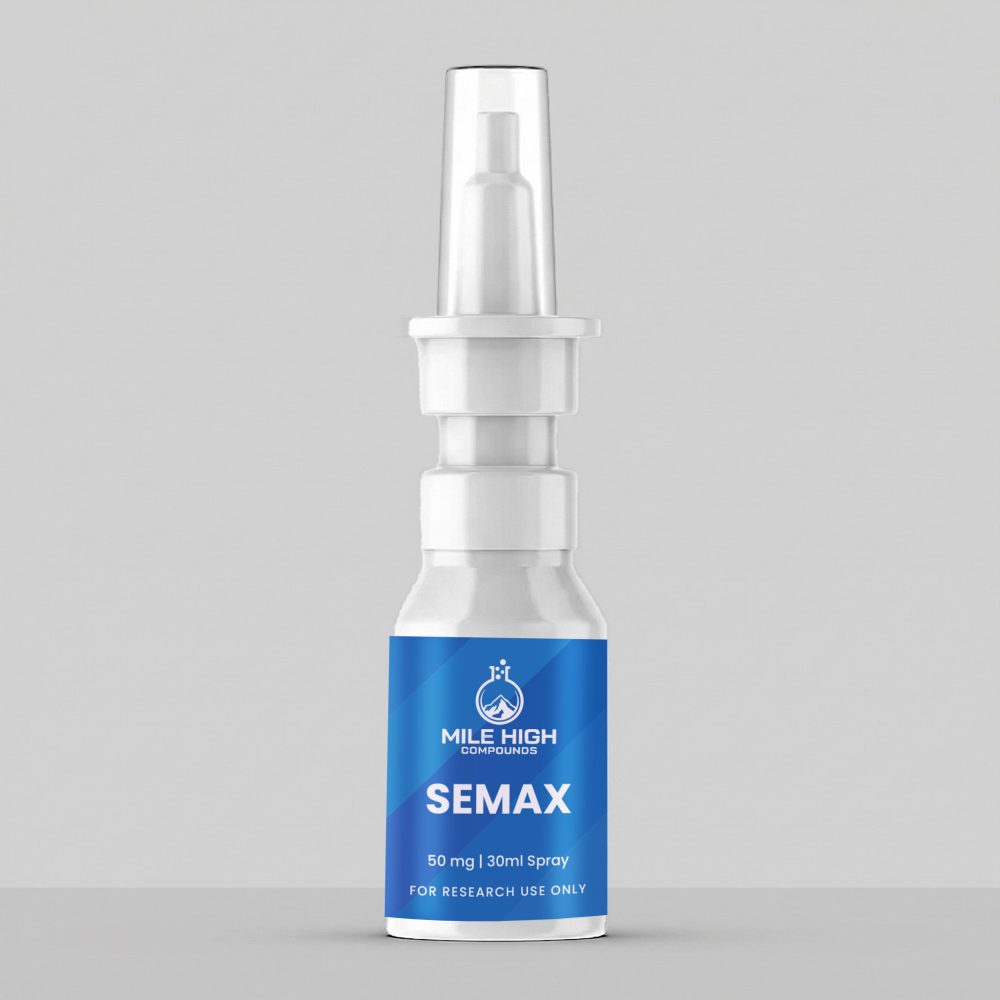
Semax Spray: 7 Essential Facts About Cognitive Research, Brain Health, and Safety
Semax Spray is a nasal formulation associated with research into neuroactive peptides, cognitive function, and neurological processes. Semax is a synthetic seven-amino-acid peptide derived from a fragment of adrenocorticotropic hormone (ACTH). It has been investigated primarily in Russian research settings for its potential neurological and neuroprotective effects.
Interest in Semax has grown in nootropic and peptide research communities, but scientific interest should not be confused with proven effectiveness. Although some human studies have been published, the available evidence has important limitations, including a lack of large, independently replicated clinical trials and comprehensive long-term safety data.
This guide from Mile High Compounds explores seven essential facts about Semax Spray, its proposed mechanisms, the research evidence, and safety considerations.
1. What Is Semax Spray?
Semax is a synthetic heptapeptide with the amino acid sequence Met-Glu-His-Phe-Pro-Gly-Pro. It is derived from a portion of ACTH, a hormone involved in the body’s endocrine system, but Semax is modified to produce a distinct biological profile.
Semax has been developed and used as a medicine in Russia, where intranasal formulations have been studied for neurological indications. In other countries, it is often discussed as an experimental nootropic—a substance investigated for possible effects on cognition and brain function.
The term Semax Spray describes a delivery format rather than a guarantee of a standardized or approved medicine. Commercial formulations can differ in composition, concentration, quality, and manufacturing standards. Consequently, evidence concerning a particular studied formulation cannot automatically be applied to every product marketed under the Semax name.
2. Why Is Semax Studied in Brain Research?
Researchers have investigated Semax because of its potential relationship to neuroprotection, neuronal signaling, and recovery following neurological injury.
Some preclinical research has explored pathways involving brain-derived neurotrophic factor (BDNF), a protein associated with neuronal survival, plasticity, and the formation and maintenance of neural connections.
These findings have generated interest in understanding whether Semax influences biological pathways relevant to neurological function. However, a change in a biomarker or signaling pathway does not necessarily mean a person will experience better memory, concentration, or recovery from brain injury.
The scientific questions remain whether reported effects are reproducible, whether they translate into meaningful clinical outcomes, and which effects—if any—can be demonstrated reliably in well-designed human trials.
3. What Does Research Say About Memory and Cognitive Function?
Semax is frequently discussed in relation to memory, attention, learning, and mental performance. These are research questions rather than established benefits for healthy people.
Some studies conducted in Russia have examined Semax in clinical neurological settings, while other investigations have explored brain activity and biological mechanisms. The evidence base includes different study designs and patient populations, so the results cannot be generalized to every possible use.
In particular, evidence from patients receiving treatment for a neurological condition would not establish that Semax enhances memory or productivity in healthy individuals.
Large, well-controlled studies would be needed to determine whether Semax produces consistent improvements in validated cognitive tests, whether any effects are clinically meaningful, and how its risks compare with potential benefits.
4. What Is Known About Semax and Neuroprotection?
Neuroprotection refers to processes that may help preserve neurons or limit damage under certain conditions. Researchers have examined Semax in experimental models and in some clinical settings involving neurological injury or disease.
Published literature includes studies concerning ischemic stroke and optic nerve disorders. For example, a PubMed-indexed report examined Semax as part of a treatment approach for optic nerve disease. Such findings provide context for why the compound has attracted neurological research interest, but they do not establish that Semax is an effective treatment under current international clinical standards.
Study design is especially important when interpreting this literature. Small samples, limited blinding, comparison treatments, and differences in clinical practice can make it difficult to determine how much of an observed improvement is attributable to the compound itself.
Semax should therefore not be considered a substitute for emergency stroke treatment, prescribed neurological care, or established rehabilitation.
5. How Is Nasal Delivery Relevant to Semax Research?
Intranasal delivery is used in research because the nasal cavity provides a route for administering certain substances without swallowing them. For some molecules, nasal delivery may offer different absorption characteristics than oral administration.
However, nasal delivery does not automatically guarantee that a peptide reaches the brain in a particular concentration or produces a predictable effect. Absorption can depend on the formulation, the integrity of the peptide, the delivery device, and the characteristics of the nasal tissues.
The U.S. FDA’s review noted that it could not identify human pharmacokinetic studies establishing how Semax free base or Semax acetate behaves in the body following administration. This limits the ability to draw reliable conclusions about exposure, distribution, and duration of action.
Research on one nasal formulation also cannot establish the performance or safety of every commercial spray. Product identity, formulation quality, and appropriate testing remain important considerations.
6. What Are the Safety and Regulatory Considerations?
Semax’s safety profile is not comprehensively established by large, high-quality clinical studies. Published reports do not provide a sufficient basis for assuring users about long-term effects, interactions with medications, or safety across different populations.
The FDA has raised concerns about insufficient safety information for Semax preparations considered for compounding, including potential immunogenicity associated with aggregation and peptide-related impurities. The agency has also noted the lack of human pharmacokinetic data it could identify for the forms reviewed.
Semax is not an FDA-approved drug in the United States. Its regulatory status differs by jurisdiction, and authorization in one country does not establish approval elsewhere.
People should not assume that a product is safe simply because it is sold online, labeled as a research compound, or delivered as a nasal spray. Anyone considering an experimental product should discuss the risks with a qualified healthcare professional, particularly when taking medication or managing a neurological condition.
7. What Does Future Semax Research Need to Establish?
Further research could help clarify Semax’s pharmacology, absorption, potential mechanisms, and clinical relevance. Priority areas include independently replicated trials, standardized formulations, reliable safety monitoring, and studies that assess meaningful outcomes rather than relying solely on biomarkers.
Researchers would also need to examine potential adverse effects, medication interactions, differences between patient groups, and the consequences of repeated or long-term exposure.
Until these gaps are addressed, Semax remains a compound with some published human research but substantial uncertainty about its overall effectiveness and safety across proposed uses.
Frequently Asked Questions About Semax Spray
What is Semax Spray?
Semax Spray is a nasal formulation of Semax, a synthetic seven-amino-acid peptide derived from an ACTH fragment. It has been investigated for potential neurological and neuroprotective effects.
Does Semax improve memory and focus?
Research has explored possible cognitive effects, but the evidence is insufficient to establish reliable cognitive enhancement in healthy people. Larger and independently replicated clinical trials are needed.
Has Semax been studied in humans?
Yes. Published human studies exist, particularly in Russian clinical literature. However, the evidence has limitations, and it does not establish the safety and effectiveness of all commercial Semax formulations.
Is Semax Spray FDA-approved?
No. Semax is not an FDA-approved drug in the United States. Regulatory status and permitted uses vary by country.
Is Semax Spray safe?
Its safety is not comprehensively established. Questions remain about long-term effects, pharmacokinetics, product quality, and potential adverse reactions. Medical guidance is advisable before considering an experimental compound.
Is Semax the same as Selank?
No. Semax and Selank are different synthetic peptides with different starting structures and research histories. Findings for one should not be assumed to apply to the other.
Conclusion
Semax Spray is associated with research into neuroactive peptides, cognitive processes, and neuroprotection. Published studies provide scientific context for continued investigation, but important uncertainties remain regarding effectiveness, delivery, and long-term safety.
For readers exploring nootropic and peptide research, it is essential to distinguish preliminary findings from established clinical benefits. Mile High Compounds supports evidence-based information, transparent product descriptions, and responsible discussion of experimental compounds.
Educational disclaimer: This article is for educational purposes only and is not medical advice. It does not recommend the use of Semax Spray or establish that it is safe or effective for any particular condition.


Reviews
There are no reviews yet.