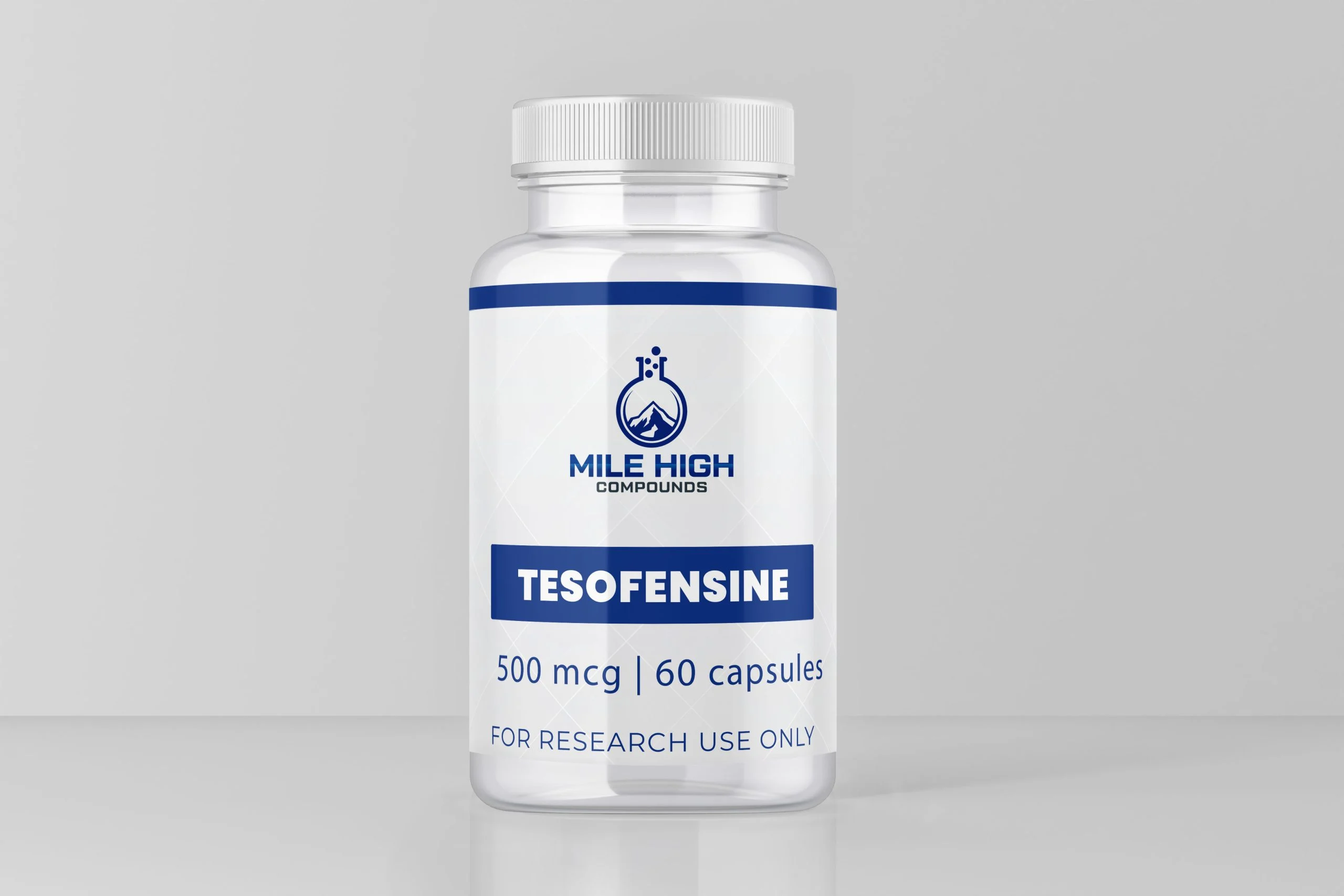
Tesofensine Capsules: 7 Essential Facts About Weight Loss, Research, and Safety
Introduction
Tesofensine Capsules are associated with research into appetite regulation, body weight, and metabolic health. Tesofensine is an experimental small-molecule drug candidate that inhibits the reuptake of three neurotransmitters: dopamine, serotonin, and noradrenaline. These chemical messengers are involved in appetite, motivation, and other neurological functions.
Unlike many compounds discussed in peptide research, tesofensine is not a peptide. It has been investigated in human clinical trials for obesity, with studies reporting weight reduction alongside important safety considerations.
Although the clinical findings have attracted interest, tesofensine should not be confused with an established, universally approved weight-management medication. Its regulatory status varies by jurisdiction, and the evidence must be considered alongside cardiovascular effects, adverse events, and outstanding safety questions.
This Mile High Compounds guide examines seven essential facts about tesofensine research, its proposed mechanisms, clinical evidence, and safety considerations.
1. What Is Tesofensine?
Tesofensine is an investigational small molecule originally explored in neurological research before attracting interest as a potential obesity treatment.
Its primary pharmacological action involves inhibiting the reuptake of dopamine, serotonin, and noradrenaline. By affecting the availability of these neurotransmitters, tesofensine may influence appetite-related signaling and food-seeking behavior.
This mechanism differs from that of peptide compounds and medications that act primarily through GLP-1 receptors. Tesofensine’s effects are related to neurotransmitter signaling in the central nervous system. Tesofensine Capsules Tesofensine Capsules Tesofensine Capsules Tesofensine Capsules Tesofensine Capsules Tesofensine Capsules Tesofensine Capsules
Research into tesofensine has progressed beyond laboratory experiments to human clinical trials. However, evidence of activity in clinical studies does not automatically mean a product sold online has the same quality, formulation, or safety profile as the investigational product evaluated in those trials.
2. How Does Tesofensine Work?
Tesofensine inhibits the reuptake of three monoamine neurotransmitters: dopamine, serotonin, and noradrenaline. These neurotransmitters participate in multiple functions, including appetite regulation, mood, alertness, and motivation.
Researchers have proposed that changes in these signaling systems may contribute to reduced appetite and lower food intake. This provides a scientific rationale for investigating tesofensine as a potential obesity treatment.
However, these neurotransmitters also influence cardiovascular and neurological functions. Consequently, the same mechanism associated with appetite-related effects may also contribute to unwanted reactions, including increased heart rate, sleep disturbances, or mood-related symptoms.
Understanding a drug’s mechanism is therefore important for evaluating both its potential benefits and its risks. A plausible mechanism alone cannot establish that a treatment is appropriate or safe for a particular person.
3. What Do Clinical Studies Say About Weight Loss?
Tesofensine has been investigated in human obesity trials. In a randomized, double-blind, placebo-controlled Phase 2 study published in The Lancet in 2008, 203 adults with obesity were assigned to different tesofensine groups or placebo for 24 weeks alongside an energy-restricted diet.
The study reported greater average weight reduction in the tesofensine groups than in the placebo group. The investigators also documented adverse effects, including dry mouth, nausea, constipation, and insomnia. Heart rate increased in the group receiving 0.5 mg. https://pubmed.ncbi.nlm.nih.gov/18950853/
These findings are relevant, but they require context. The publication subsequently received an expression of concern following questions about trial conduct and adverse-event reporting. The results should therefore not be treated as definitive proof of the drug’s overall benefit-risk profile. https://pubmed.ncbi.nlm.nih.gov/23561987/
A later Phase 3 program conducted in Mexico also reported weight-loss outcomes. Its results provide additional clinical information, but regulatory approval and the quality of the available evidence must be considered separately.
Overall, tesofensine has shown weight-loss activity in clinical research, but this does not establish that every capsule sold online will produce comparable outcomes.
4. Tesofensine and Appetite Regulation
Appetite regulation is a major area of interest in tesofensine research. Because the compound affects neurotransmitter signaling, researchers have investigated whether it changes hunger, fullness, and food intake.
A small controlled study in overweight and moderately obese men reported changes in appetite sensations and food intake during short-term treatment. However, the study was small and brief, so its findings cannot establish long-term effectiveness or safety. https://pubmed.ncbi.nlm.nih.gov/20479765/
Appetite is influenced by numerous biological, psychological, and environmental factors. A drug’s effect on appetite does not necessarily translate into sustained weight reduction, improved health outcomes, or lasting changes in eating behavior.
Longer-term studies must consider treatment adherence, changes in body composition, adverse effects, and whether weight changes are maintained after treatment ends.
For these reasons, claims that tesofensine guarantees appetite suppression or effortless weight loss are not scientifically justified.
5. Safety, Side Effects, and Cardiovascular Considerations
Safety is an essential part of evaluating tesofensine. Clinical research has reported adverse effects such as dry mouth, nausea, constipation, diarrhea, and insomnia. Increases in heart rate have also been observed, and some studies have raised concerns about blood pressure and other cardiovascular effects.
Because tesofensine affects multiple neurotransmitter systems, its interaction profile deserves careful evaluation. Potential interactions with other medications, particularly those that influence serotonin, noradrenaline, or cardiovascular function, require professional assessment.
The available evidence does not establish that all formulations marketed as tesofensine capsules have the same safety profile as products used in controlled trials. Product purity, actual ingredient content, and manufacturing standards may vary.
Anyone experiencing chest pain, fainting, severe palpitations, or other potentially serious symptoms requires urgent medical assessment. Experimental compounds should not be used to replace established medical care.
6. Regulatory Status and Availability
Tesofensine has been investigated as a potential treatment for obesity, but clinical development is not equivalent to regulatory approval.
In the United States, tesofensine is not FDA-approved as an obesity medication. Its regulatory history in Mexico has also involved a review process rather than a straightforward approval: the development partner reported that its application had not been approved in November 2024 and was resubmitted to COFEPRIS in February 2025. https://saniona.com/wp-content/uploads/2026/04/SANIONA-annual-report-2025-UK.pdf
Regulatory status can change, so readers should verify the current position with the relevant national medicines regulator.
Online availability does not establish that a product is an approved medicine, has undergone appropriate manufacturing controls, or is suitable for human use. A research label or product listing should not be interpreted as evidence of clinical approval.
7. What Future Research Is Needed?
Although tesofensine has progressed through multiple stages of clinical investigation, important questions remain about its long-term benefit-risk profile and its role in obesity treatment.
Further evaluation should consider cardiovascular safety, psychiatric effects, drug interactions, long-term outcomes, and the durability of weight reduction. Independent scrutiny of study design and adverse-event reporting is also important when interpreting the clinical literature.
Researchers and regulators must assess whether the expected benefits outweigh the risks for the intended population and whether a standardized formulation can be manufactured consistently.
Until the relevant regulatory and clinical requirements are satisfied in a given jurisdiction, tesofensine should not be described as an established, approved weight-loss treatment there.
Frequently Asked Questions
What are tesofensine capsules?
They are oral formulations containing tesofensine, a small-molecule drug candidate investigated for its effects on appetite and body weight.
Is tesofensine a peptide?
No. Tesofensine is a small molecule that affects the reuptake of dopamine, serotonin, and noradrenaline.
Has tesofensine been studied in humans?
Yes. Human clinical studies have investigated its potential for weight reduction. However, clinical findings do not establish that every commercially available product is safe or effective.
Is tesofensine FDA-approved?
No. Tesofensine is not FDA-approved as a weight-loss medication in the United States.
What safety concerns have been reported?
Clinical studies have reported gastrointestinal symptoms, dry mouth, insomnia, and increases in heart rate. The full long-term safety profile remains an important consideration.
Does online availability prove that tesofensine is safe?
No. Online availability does not establish regulatory approval, product quality, or clinical safety.
Conclusion
Tesofensine Capsules are associated with clinical research into appetite regulation and weight reduction. Unlike many experimental peptides, tesofensine has been evaluated in human obesity studies, and some results have shown meaningful weight-loss effects. Nevertheless, adverse effects, cardiovascular considerations, questions about the evidence, and unresolved regulatory issues remain important.
For anyone researching tesofensine, the key is to distinguish clinical trial findings from proof that a particular marketed product is approved, reliable, and appropriate for human use. Regulatory status should be checked locally, and decisions involving weight-management medication should be made with a qualified healthcare professional.
Educational disclaimer: This article is for informational and educational purposes only. It is not medical advice and does not recommend the use of tesofensine capsules. Tesofensine is not FDA-approved as a weight-loss medication in the United States. Consult a qualified healthcare professional regarding evidence-based weight-management options.


Reviews
There are no reviews yet.