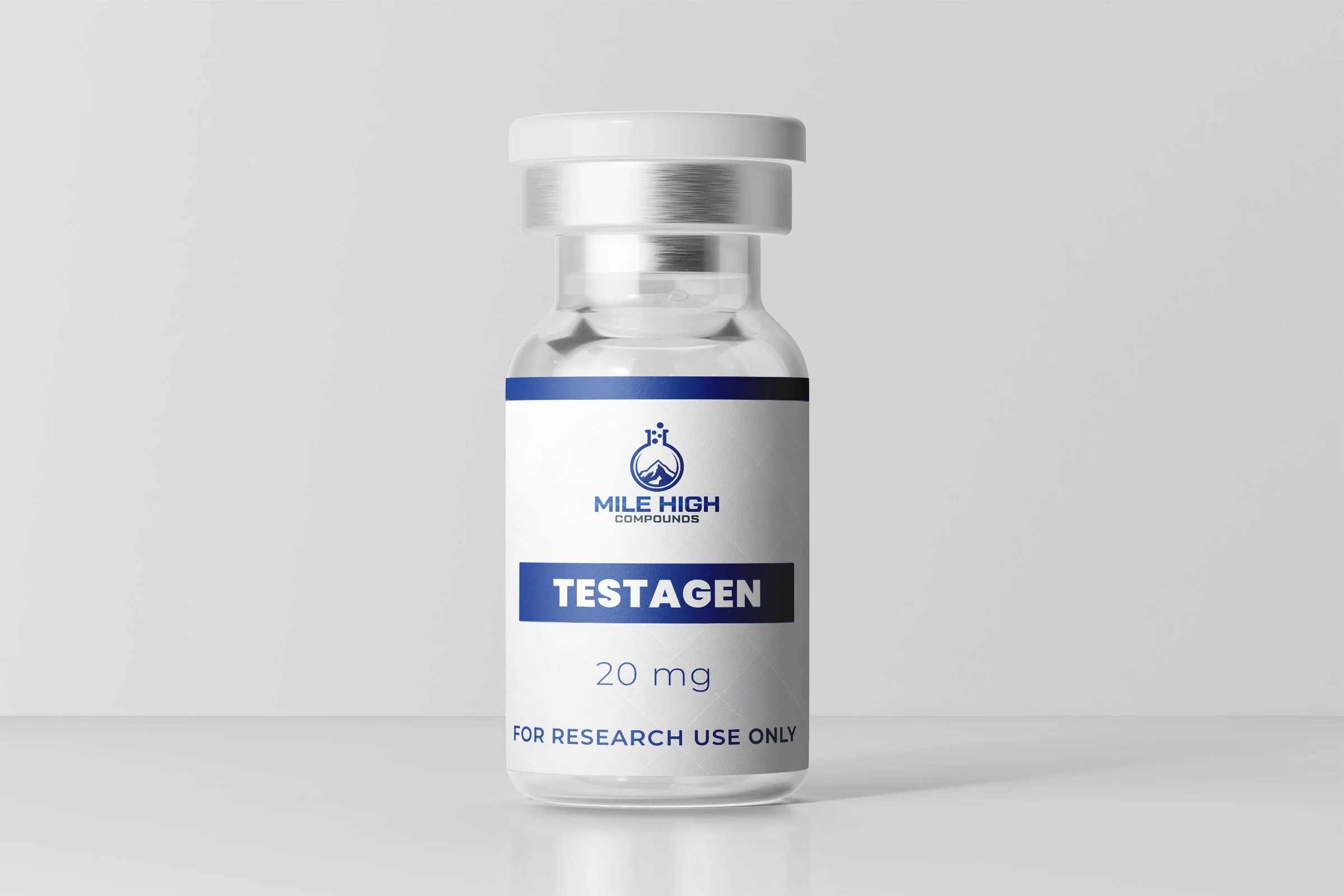
Testagen: 7 Essential Facts About Peptide Research, Hormones, and Safety
Introduction
Testagen is an experimental peptide associated with the short-peptide bioregulator research tradition. It is commonly identified as a synthetic tetrapeptide consisting of four amino acids: lysine, glutamic acid, aspartic acid, and glycine, abbreviated KEDG.
This is marketed online in connection with testicular health, hormonal function, and male reproductive wellness. However, these marketing claims go beyond what the available scientific evidence can establish. Research on this is limited, and reliable human clinical evidence demonstrating its effectiveness or safety is lacking. 【turn106307search1】【turn106307search5】
At Mile High Compounds, understanding experimental compounds requires distinguishing proposed biological mechanisms from demonstrated clinical outcomes. This guide reviews It’s identity, research background, evidence limitations, and safety considerations.
1. What Is Testagen?
This is described in research and peptide reference sources as a synthetic four-amino-acid peptide, also known as KEDG. It belongs to a broader family of short peptides associated with Russian bioregulator research.
Researchers have investigated certain short peptides for their possible interactions with cells, DNA, and biological signaling pathways. However, these general research interests do not establish that it has a specific therapeutic effect.
The name may suggest a direct relationship with testosterone or testicular function, but a product’s name is not scientific evidence. Its identity, purity, formulation, and biological effects must be evaluated independently.
2. What Does the Research Say About Testagen?
The available research on it is limited primarily to laboratory experiments and animal studies involving related biological questions. Some research has examined peptide interactions with cellular components, while other investigations have explored endocrine-related tissues in animal models.
These studies can help researchers develop hypotheses about possible biological activity. They do not, however, establish that the improves reproductive health, increases testosterone, or treats hormonal disorders in humans.
Independent replication is another important limitation. Much of the research associated with this peptide family comes from a relatively narrow research tradition, making independent confirmation especially important.
Accordingly, it should be described as an experimental research peptide rather than a clinically established treatment. 【turn106307search4】【turn106307search5】
3. Testagen and Testosterone: Separating Claims From Evidence
One of the most common themes in the marketing is its proposed relationship with testosterone and male hormonal function.
However, the available evidence does not establish that Testagen reliably increases testosterone in humans. Robust controlled clinical trials demonstrating improvements in testosterone levels, sperm quality, fertility, or other male reproductive outcomes have not been established.
Hormonal function is complex and can be influenced by numerous factors, including age, underlying medical conditions, medications, sleep, and metabolic health.
It is therefore important not to interpret theoretical endocrine activity as proof of a clinically meaningful hormonal effect. Anyone concerned about testosterone or fertility should seek appropriate medical assessment rather than relying on experimental peptides.
4. Understanding the Bioregulator Hypothesis
This is associated with a research framework proposing that certain short peptides may influence cellular processes and gene expression.
Some laboratory studies have investigated how short peptides interact with cellular structures and genetic material. Such findings may be relevant to basic biological research, but they do not demonstrate that a peptide selectively regulates a particular organ or produces a beneficial outcome in people.
For Testagen specifically, a reliable clinical mechanism linking its proposed activity to improved testicular function has not been established.
A plausible mechanism is only one part of scientific validation. Researchers must also establish reproducible effects, appropriate pharmacology, safety, and meaningful clinical outcomes before a compound can be considered an evidence-based treatment.
5. What Are the Potential Benefits of Testagen?
Online descriptions sometimes associate Testagen with reproductive health, hormonal balance, or broader endocrine support. These should be understood as proposed or marketed uses rather than established benefits.
At present, there is insufficient high-quality human evidence to confirm that Testagen provides these outcomes. Evidence involving other peptides in the same research family cannot automatically be applied to it because differences in amino-acid sequence can produce different biological properties.
Claims should therefore be assessed against the quality of the underlying studies, the populations investigated, and whether independent researchers have reproduced the findings.
For scientific accuracy, Testagen’s potential applications remain investigational, and its clinical benefits are unproven.
6. Safety, Product Quality, and Regulatory Considerations
A limited evidence base also means that important safety questions remain unanswered. Reliable human data on it’s adverse effects, long-term safety, pharmacokinetics, and interactions with medications are lacking.
Product quality presents a separate concern. Products sold under the same name may differ in identity, purity, concentration, storage conditions, or manufacturing standards. A seller’s description or certificate of analysis does not establish clinical safety or effectiveness.
This is not FDA-approved as a human medical treatment in the United States. Consumers should not assume that a research-use label establishes that a product is suitable for human use.
People taking prescription medications or managing hormonal, reproductive, or other medical conditions should consult a qualified healthcare professional before considering experimental compounds.
7. The Future of Testagen Research
Further research would be needed to clarify Testagen’s biological activity and determine whether any proposed applications have clinical value.
Useful future studies would include independently verified chemical characterization, appropriate laboratory and toxicology investigations, pharmacokinetic studies, and well-designed human clinical trials where scientifically and ethically justified.
Such studies would need to evaluate meaningful outcomes rather than relying exclusively on theoretical mechanisms or indirect laboratory observations.
Until stronger evidence becomes available, it remains an experimental peptide with substantial unanswered questions. Scientific interest should not be confused with proven efficacy, and further research is necessary before reliable conclusions can be drawn about its possible role in human health.
Frequently Asked Questions
What is Testagen?
It is described as a short synthetic peptide, commonly identified as KEDG, associated with research into peptide bioregulators.
Does Testagen increase testosterone?
Reliable controlled human evidence has not established that Testagen increases testosterone or improves male reproductive function.
Is Testagen FDA-approved?
No. Testagen is not FDA-approved as a human medical treatment in the United States.
Are the benefits of Testagen scientifically proven?
No established clinical benefits have been confirmed through robust, independently replicated human trials.
Is Testagen’s long-term safety known?
No. Adequate human safety and long-term outcome data are lacking.
Conclusion
Testagen is an experimental peptide that has attracted interest within the broader field of short-peptide bioregulator research. Despite its marketing associations with male reproductive and hormonal health, current evidence does not establish that it reliably improves testosterone levels, fertility, or other clinical outcomes.
For readers exploring peptide science, the most responsible approach is to evaluate published evidence carefully, recognize the limits of preliminary research, and avoid treating unverified claims as established medical facts.
Educational disclaimer: This article is for informational and educational purposes only. It does not provide medical advice or recommend the use of experimental compounds. Testagen’s safety and effectiveness have not been established for human medical use. Consult a qualified healthcare professional for personal medical guidance.


Reviews
There are no reviews yet.