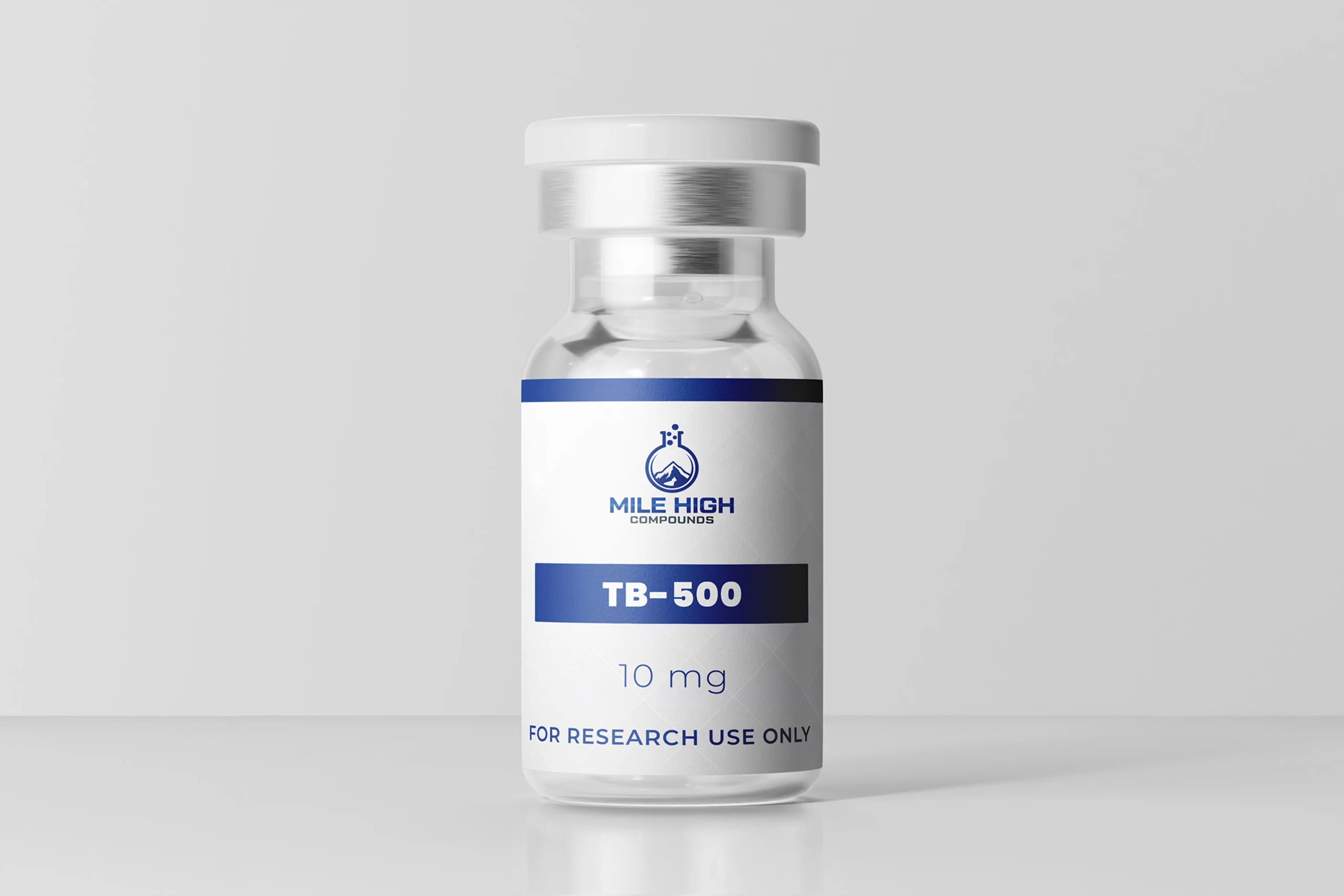
TB-500: 7 Essential Facts About Peptide Research and Safety
1. What Is TB-500?
TB-500 is a synthetic peptide commonly described as a short fragment related to thymosin beta-4, a naturally occurring protein involved in cellular processes such as actin regulation and cell movement. The name TB-500 is generally associated with the seven-amino-acid sequence LKKTETQ, often supplied in an N-terminally acetylated form. Exact molecular identity matters because different products may use similar names for different substances.
It has attracted attention in experimental research and online discussions about tissue repair, recovery, and wound healing. However, interest in a compound does not establish that it is effective or safe for human use.
At Mile High Compounds, our goal is to provide science-driven information that distinguishes laboratory findings from clinical evidence and explains important safety limitations.
2. Essential Facts About TB-500 Peptide Research
Research associated with that is often discussed alongside studies of thymosin beta-4. Although these substances are related, they are not interchangeable.
Thymosin beta-4 is a larger, naturally occurring peptide that has been investigated in cellular and clinical research. this, by contrast, is a short synthetic fragment. Results involving the full-length molecule cannot automatically establish the biological effects, safety, or effectiveness of the fragment.
Researchers have studied thymosin beta-4 in areas involving cell migration, actin dynamics, and tissue-related processes. These findings provide scientific context for interest in related fragments, but direct evidence concerning it remains limited.
The distinction is especially important when evaluating commercial descriptions. A reference to thymosin beta-4 research does not necessarily mean that the specific the product being marketed has been tested in the same way.
3. TB-500 and Wound-Healing Research
Wound healing is one of the principal areas associated with it in commercial discussions. The broader scientific interest comes partly from research on thymosin beta-4 and its relationship with cellular movement and tissue biology.
Wound healing involves several overlapping stages, including inflammation, cell migration, tissue formation, and remodeling. Researchers investigate how signaling molecules influence these processes and whether particular compounds might have therapeutic applications.
However, evidence from experiments involving the full-length thymosin beta-4 protein does not establish that TB-500 produces the same effects. The FDA’s review of this-related substances reported that it had not identified clinical studies establishing their use in humans for wound healing. <Cite refs={[“turn570824search24”]}/>
Consequently, claims that it reliably accelerates wound closure, repairs tendons, restores ligaments, or treats injuries are not established clinical conclusions. More direct research would be necessary to evaluate any such proposed applications.
4. TB-500, Cellular Movement, and Tissue Biology
Thymosin beta-4 has been investigated for its interaction with actin, a protein that helps cells maintain their structure and move. Cell movement is relevant to many biological processes, including tissue development and repair.
This research helps explain why thymosin beta-4-related substances have attracted interest in regenerative medicine. Nevertheless, a plausible biological mechanism does not demonstrate a clinical benefit.
The effects of a peptide depend on its molecular structure, formulation, biological activity, and the context in which it is studied. A short fragment may not reproduce the activity of the full-length molecule, and the results of one experimental model may not apply to another.
For it specifically, high-quality human evidence is insufficient to establish reliable effects on recovery, athletic performance, muscle development, or tissue regeneration. Such claims should be considered unproven rather than accepted on the basis of laboratory findings or testimonials.
5. TB-500 Safety and Regulatory Status
Safety is an important consideration when evaluating it. It is not an FDA-approved drug for human treatment in the United States.
The FDA has identified potential safety concerns involving compounded thymosin beta-4 fragment products, including this. These concerns include possible immune responses related to peptide aggregation and peptide-related impurities. The agency also reports a lack of adequate human safety information for the proposed uses. <Cite refs={[“turn570824search0″,”turn570824search24”]}/>
Immunogenicity refers to the possibility that a substance may trigger an immune response. Depending on the circumstances, immune responses can range from having no obvious clinical effect to causing serious complications. Peptide aggregation and impurities can complicate the assessment of these risks.
Products sold online may also vary in identity, purity, concentration, storage conditions, and manufacturing quality. A supplier’s certificate of analysis does not independently establish that a product is suitable for human administration.
In July 2026, the FDA’s Pharmacy Compounding Advisory Committee reviewed it-related bulk drug substances for possible inclusion on a compounding list. An advisory committee discussion or recommendation is not equivalent to FDA drug approval. <Cite refs={[“turn570824search1″,”turn570824search23”]}/>
6. Understanding the Limitations of TB-500 Research
Several limitations should be considered when interpreting claims about TB-500.
- Limited direct human evidence: The FDA reported that it had not identified human exposure data for drug products containing the specified TB-500 fragment.
- Molecular differences: Research on full-length thymosin beta-4 cannot automatically be applied to the TB-500 fragment.
- Unestablished effectiveness: Reliable clinical benefits for wound healing or injury recovery have not been established.
- Uncertain long-term safety: Available evidence does not adequately characterize potential long-term risks.
- Product-quality concerns: Identity, purity, aggregation, and impurities can affect a peptide product’s safety.
These limitations do not mean that every research question about thymosin beta-4-related biology lacks scientific value. They mean that the evidence for the specific of fragment must be evaluated independently.
Future studies would need to establish the precise molecular identity, characterize the formulation, evaluate safety, and test meaningful clinical outcomes in appropriately designed human trials.
7. Frequently Asked Questions About TB-500
What is TB-500?
This is commonly described as a synthetic seven-amino-acid fragment related to thymosin beta-4. Exact molecular identity is important because product naming can vary.
What is TB-500 studied for?
This is discussed in relation to wound healing and tissue biology. However, evidence directly establishing its effectiveness in humans is lacking.
Is TB-500 FDA-approved?
No. this is not an FDA-approved drug for human treatment in the United States.
Is TB-500 the same as thymosin beta-4?
No. it generally refers to a short fragment, while thymosin beta-4 is a larger, naturally occurring peptide. Findings involving one should not automatically be attributed to the other.
Is the safety of TB-500 established?
No. Important questions remain regarding human safety, immune responses, peptide aggregation, impurities, and potential effects over time.
Conclusion: Making Informed Decisions About TB-500
This has attracted interest because of its relationship to thymosin beta-4 and research into cellular movement and tissue biology. However, the evidence directly supporting TB-500’s effectiveness and safety in humans remains insufficient.
Understanding the difference between related molecules, laboratory findings, and clinical outcomes is essential when evaluating this compound. Mile High Compounds encourages readers to prioritize credible scientific evidence, accurate product identification, and qualified medical guidance over unsupported claims.
Educational disclaimer: This article is for informational and educational purposes only. It does not provide medical advice, diagnose or treat any condition, or recommend the use of TB-500. Consult a qualified healthcare professional regarding medical concerns and treatment decisions.


Reviews
There are no reviews yet.