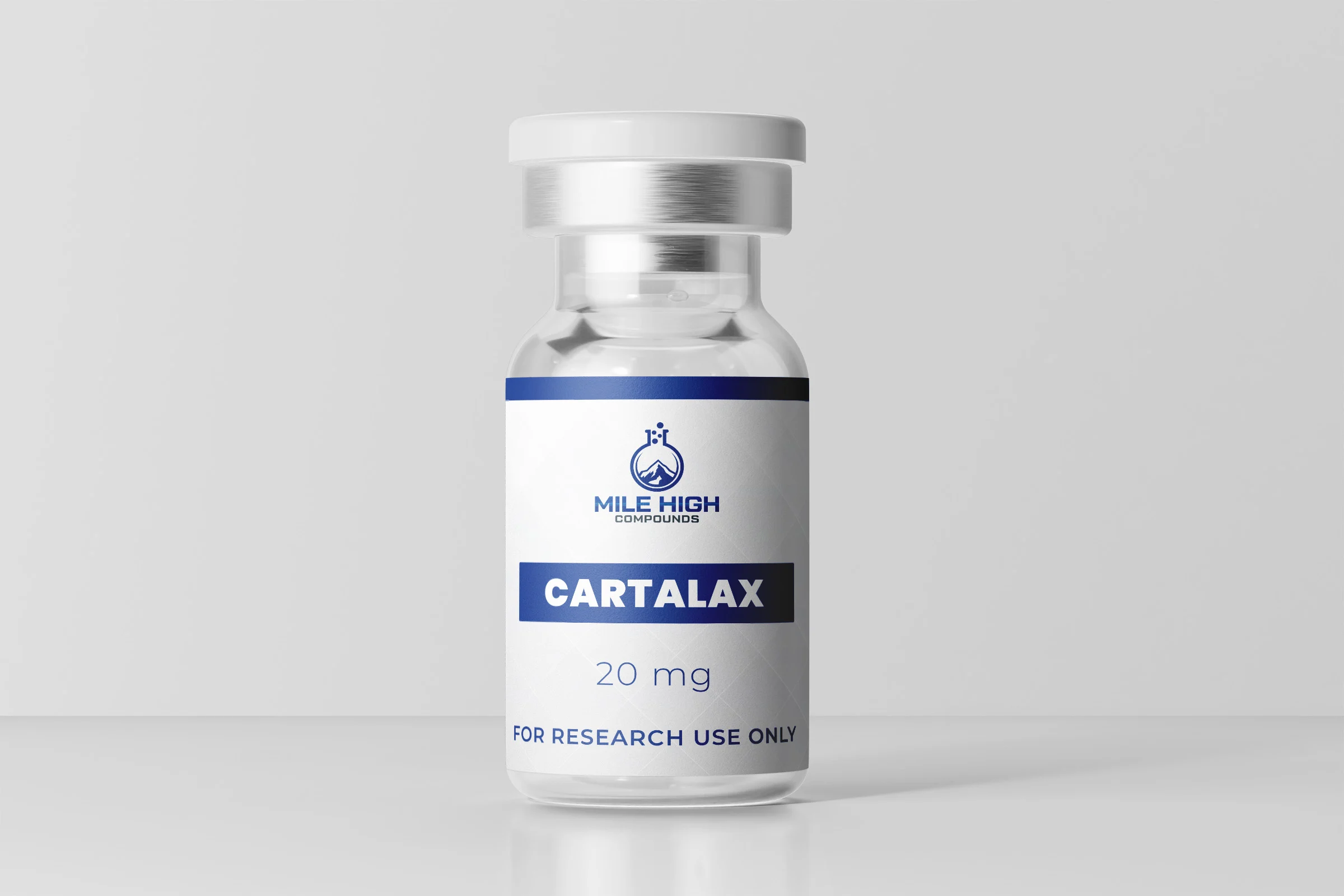
Cartalax: 7 Essential Facts About Cartilage Research and Safety
Cartalax is an experimental short peptide associated with research into cartilage, connective tissue, and cellular aging. It belongs to the peptide bioregulator research tradition developed by researchers in Russia. Interest in Cartalax has grown alongside broader curiosity about peptides and their potential roles in biological signaling. However, scientific interest should not be confused with proven clinical benefits.
This guide from Mile High Compounds explores Cartalax’s reported structure, current research, proposed mechanisms, evidence limitations, safety questions, and regulatory status.
1. What Is Cartalax?
This is commonly identified as a synthetic tripeptide composed of three amino acids: alanine, glutamic acid, and aspartic acid. Its sequence is written as Ala-Glu-Asp or AED, and some research sources associate it with the designation T-31.
It is described within the Khavinson peptide bioregulator framework, which investigates whether short peptides can influence cellular activity and gene expression. It is marketed in some research and supplement contexts as a cartilage-associated bioregulator.
However, commercial descriptions are not equivalent to verified scientific findings. Researchers and consumers should also distinguish Cartalax from Epitalon, a different peptide with the four-amino-acid sequence Ala-Glu-Asp-Gly. Similar naming conventions do not mean the compounds are interchangeable.
2. How Does Cartalax Supposedly Work?
The proposed mechanism involves changes in cellular signaling and gene expression associated with tissue maintenance. Researchers have investigated whether short peptides can influence proteins and biological pathways involved in cellular differentiation and aging.
For it, the central hypothesis is that it could affect processes associated with cartilage-forming cells and extracellular matrix components. The extracellular matrix is the network of proteins and other substances that supports tissue structure.
These ideas remain research hypotheses rather than established therapeutic mechanisms. It has not been conclusively demonstrated that it selectively targets cartilage in the human body, reaches the relevant tissues intact, or produces a predictable biological response after administration.
3. What Does the Scientific Research Show?
Some laboratory research associated with the AED peptide has examined cellular aging and cartilage-related markers. A 2023 study investigated chondrogenic differentiation in aging human mesenchymal stem-cell cultures, reporting changes in markers associated with cartilage development.
These findings provide a starting point for further investigation, but they have important limitations. Cells grown in a laboratory do not reproduce the full complexity of a living joint, where blood supply, immune responses, mechanical forces, metabolism, and other tissues influence outcomes.
The published evidence also needs independent replication. Findings from a limited research network cannot establish broad clinical effectiveness, and changes in laboratory markers do not necessarily translate into improved mobility, less pain, or healthier joints.
4. Cartalax and Joint Health: What Is Actually Known?
This is commonly promoted online for cartilage support, joint health, and age-related tissue maintenance. These claims should be treated cautiously.
Laboratory findings involving cartilage-associated cells do not prove that it can rebuild damaged cartilage, reverse osteoarthritis, reduce joint pain, or improve physical performance in people. Such claims require well-designed human studies measuring meaningful clinical outcomes.
It is also important to distinguish the synthetic AED peptide from cartilage-derived preparations discussed in some related literature. Evidence about a tissue extract or another compound cannot automatically be attributed to this itself.
At present, the available evidence does not establish it as a proven treatment for arthritis, cartilage damage, or other musculoskeletal conditions.
5. Safety, Tolerability, and Research Limitations
A major limitation is the lack of a well-established human safety profile for Cartalax. Without adequate clinical studies, its potential adverse effects, interactions, pharmacokinetics, and effects of repeated exposure remain uncertain.
Product quality is another consideration. Research chemicals sold online may vary in identity, purity, concentration, storage conditions, and contamination risk. A seller’s label or certificate does not, by itself, establish that a product is suitable for human use.
There is insufficient evidence to determine whether it is safe for particular populations, including people with chronic illnesses, those taking medication, or individuals who are pregnant or breastfeeding. Experimental compounds should not replace medical assessment or established treatments.
6. Is Cartalax FDA-Approved?
This is not an FDA-approved medicine in the United States. The available evidence reviewed for this article does not establish authorization for treating joint disease, repairing cartilage, or preventing aging-related tissue changes.
A compound’s availability through an online vendor does not demonstrate regulatory approval, clinical effectiveness, or safety for human consumption or injection. Research-use labeling also does not make an unapproved product suitable for self-experimentation.
Regulatory status can differ between countries, so anyone evaluating a product should consult the relevant national medicines authority. Researchers should follow applicable institutional, ethical, and laboratory safety requirements.
7. What Should Readers Consider Before Evaluating Cartalax?
A responsible evaluation starts with separating established facts from proposed benefits. it has a commonly reported chemical identity and limited laboratory research, but its clinical value remains uncertain.
When reviewing scientific or commercial information, consider these questions:
- Does the source cite a peer-reviewed study of this itself?
- Was the research conducted in cells, animals, or humans?
- Were outcomes independently replicated?
- Did the study measure meaningful health outcomes or only laboratory markers?
- Is the product’s identity and purity independently verified?
- Are safety information and regulatory claims supported by reliable documentation?
These questions help readers assess peptide-related claims more critically. Stronger evidence would require reproducible preclinical findings, appropriate toxicology studies, and carefully designed human trials.
Frequently Asked Questions About Cartalax
What is Cartalax used for?
This is marketed as a cartilage-associated peptide bioregulator. Its proposed applications relate to cartilage and cellular aging, but its effectiveness for these purposes has not been established in robust human clinical trials.
Is Cartalax the same as Epitalon?
No. Cartalax is generally described as Ala-Glu-Asp, a three-amino-acid peptide. Epitalon is Ala-Glu-Asp-Gly, a four-amino-acid peptide. They are distinct compounds.
Does Cartalax rebuild cartilage?
There is insufficient clinical evidence to conclude that it rebuilds cartilage or reverses joint damage in humans. Laboratory findings are not proof of clinical benefit.
Are Cartalax’s long-term effects known?
No reliable long-term human safety profile has been established. Potential adverse effects and interactions remain insufficiently characterized.
Is Cartalax approved to treat arthritis?
This is not FDA-approved to treat arthritis or other joint conditions in the United States.
Conclusion
It is an experimental tripeptide associated with research into cartilage-related cellular processes. Although laboratory findings offer questions worth investigating, they do not establish that the compound improves joint health, repairs cartilage, or is safe for human use. More rigorous research and independent replication are needed before meaningful therapeutic conclusions can be drawn.
Educational disclaimer: This article is for informational and scientific education purposes only. It is not medical advice and does not recommend the use of experimental compounds to diagnose, treat, cure, or prevent any disease.


Reviews
There are no reviews yet.